News & Trends
The US obesity rate appears to be falling — and 1 in 9 adults now say they take a GLP-1
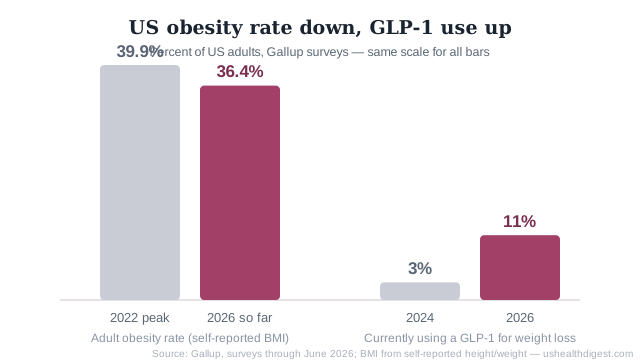
After decades of climbing, the US adult obesity rate is moving in the other direction. Gallup's July 2026 report puts it at 36.4% thus far in 2026, down from a 39.9% peak in 2022 — over the same stretch in which the share of US adults currently taking a GLP-1 drug for weight loss rose from 3% in 2024 to 11% in 2026, roughly one in nine. Two caveats belong in the same breath as the headline. Gallup's obesity figure is computed from self-reported height and weight, which the pollster itself says runs lower than studies that physically measure people. And Gallup shows the two trends moving together; it does not — and cannot — show that one caused the other. Read as what it is, a survey trend with its limitations attached, it is still the most notable population-level weight signal the US has produced in a generation.
What Gallup measured, and how
The report, published July 7, 2026, draws on two survey waves. GLP-1 usage questions went to 5,065 US adults surveyed May 28 to June 5, 2026, via the Gallup Panel, with a margin of error of ±1.5 percentage points at the 95% confidence level. The obesity and diabetes estimates rest on a larger base: 10,091 respondents surveyed February 18 to March 3 and May 28 to June 5, 2026. Obesity is defined the standard way — BMI of 30 or higher — but the BMI itself is arithmetic on whatever height and weight respondents typed in, not a measurement anyone took.
The headline findings, side by side:
| Measure | Earlier reading | 2026 reading | Notes |
|---|---|---|---|
| Adult obesity rate (self-reported BMI) | 39.9% (2022 peak) | 36.4% thus far in 2026 | Gallup calls the decline statistically meaningful |
| Currently taking a GLP-1 for weight loss | 3% (2024) | 11% | Roughly 1 in 9 US adults |
| Have ever taken a GLP-1 for weight loss | — | 15% | KFF found about 1 in 8 ever-users in May 2024 |
| Aware of GLP-1 drugs | 80% (2024) | 91% | Near-universal awareness |
| Diagnosed diabetes | Rising for 15 years | Steady since 2023 | A plateau, not yet a decline |
All figures are from the Gallup report. The 15% ever-use number has a useful cross-check: KFF's May 2024 tracking poll found about 1 in 8 US adults had ever used a GLP-1 — for any indication, including diabetes. Two independent pollsters landing in the same range, two years apart on an adoption curve, is the kind of consistency that makes a survey number more believable. Gallup also asked what people are taking: 68% of current users report brand-name medications, 19% compounded versions, and 12% are unsure which they have. Among those who moved from brand-name to compounded, 66% cited cost or insurance as the main reason. We track the broader numbers on this class in our GLP-1 statistics roundup.
Why self-reported BMI understates obesity
Gallup is candid about its method's known bias. A "vanity effect" in how respondents present themselves, the report notes, may explain why its obesity estimates typically run somewhat lower than those from studies using clinical measurements of height and weight. People tend to round height up and weight down, and both errors push calculated BMI lower.
The measured benchmark makes the gap concrete. CDC's National Health and Nutrition Examination Survey, which weighs and measures participants in mobile examination centers, put adult obesity at 40.3% for August 2021 through August 2023 — including 41.3% of women — at a time when Gallup's self-report series was reading around its 39.9% peak. NHANES data for the 2025–2026 period do not yet exist, so there is currently no measured series that can confirm or contradict Gallup's decline. That cuts both ways: the 36.4% figure should not be quoted as the clinical obesity rate, but a self-report bias that stays roughly constant over time would not manufacture a three-and-a-half-point downward trend out of nothing. The honest framing is that a large, consistently run survey is showing a real change in what Americans report — and the physical-measurement verdict is still a few years away.
What could explain a real decline
What follows is interpretation, clearly labeled as such — Gallup's own language is careful, describing "a statistically meaningful decline that continues to inversely track with increased usage of GLP-1 medicine nationally." Tracking inversely is correlation, not cause. That said, the drug explanation has arithmetic behind it. Eleven percent of adults on medications that produced average losses of 14.9% of body weight over 68 weeks in semaglutide's STEP 1 trial and up to 20.9% over 72 weeks in tirzepatide's SURMOUNT-1 trial is plausibly enough to move a population statistic by a few points, since losses of that size carry many individuals below the BMI-30 threshold. Gallup adds a supporting detail: usage and declining obesity generally align across age groups, with the exception of adults 65 and older.
Other explanations deserve a hearing, and none can be excluded from this data alone. Survey samples and weighting shift subtly year to year; a self-report series can drift if the social desirability of a given weight changes — plausible in a culture now saturated with weight-loss-drug coverage; and demographic turnover in who answers panels can nudge estimates. The diabetes figure complicates a purely triumphant reading too: Gallup finds diagnosed diabetes has been steady since 2023 after 15 years of rising — a plateau worth noting, but not the decline one might expect if population weight were falling sharply and durably.
There is also a durability question the survey cannot answer. In SURMOUNT-4, participants who stopped tirzepatide after 36 weeks regained a substantial share of the weight they had lost, while those who stayed on continued to lose. A population trend built partly on an 11% usage rate is therefore contingent: it depends on people staying on treatment, which in turn depends on tolerability, supply, and — above all — on who can keep paying.
Who the decline may not include
An obesity rate that falls because of a medication falls fastest among the people who can get the medication. List prices for branded GLP-1s run to hundreds of dollars a month without coverage — our cost-without-insurance guide walks through the current numbers — and insurance coverage for the weight-loss indications remains uneven, as we detail in our 2026 coverage review. Gallup's own finding that two-thirds of people who switched from brand-name to compounded versions cited cost or insurance is the same pressure showing up inside the user base itself. A national average can improve while access-shaped gaps underneath it widen; Gallup's topline cannot tell us whether that is happening, and no one should read 36.4% as evenly distributed.
What this means for women researching these drugs now
For readers weighing treatment, the Gallup report changes context more than it changes advice. Taking a GLP-1 for weight loss is now a mainstream act — one in nine adults, with 91% awareness — which matters practically for insurance politics, supply, and how candidly patients and clinicians can discuss it. The individual evidence is what it was: average trial losses of 14.9% to 20.9% of body weight over roughly a year and a half, wide person-to-person variation, and substantial regain when treatment stops. Our guide to semaglutide results in women covers what the trials — which enrolled mostly women — actually reported. The shift is generational as well: a JAMA Pediatrics analysis out this month shows 13-to-25-year-olds moving toward these drugs too, which we cover in a companion piece publishing today.
The bottom line holds the two truths at once. A survey series that tracked American weight upward for decades has turned downward by three and a half points while GLP-1 use nearly quadrupled in two years — and that same series measures self-perception as much as body mass, cannot assign cause, and says nothing about who is being left out of the decline. Both halves are the story.
Sources
- Witters, Dan. In U.S., GLP-1 Usage Reaches New High. Gallup, July 7, 2026. news.gallup.com/poll/712157
- Emmerich et al. Obesity and Severe Obesity Prevalence in Adults: United States, August 2021–August 2023. NCHS Data Brief No. 508, CDC National Center for Health Statistics. cdc.gov/nchs/products/databriefs/db508
- KFF. KFF Health Tracking Poll May 2024: The Public's Use and Views of GLP-1 Drugs. KFF, May 10, 2024. kff.org/…/kff-health-tracking-poll-may-2024
- Wilding et al. Once-Weekly Semaglutide in Adults with Overweight or Obesity (STEP 1). New England Journal of Medicine, March 18, 2021 (published online February 10, 2021). pubmed.ncbi.nlm.nih.gov/33567185
- Jastreboff et al. Tirzepatide Once Weekly for the Treatment of Obesity (SURMOUNT-1). New England Journal of Medicine, July 21, 2022. pubmed.ncbi.nlm.nih.gov/35658024
- Aronne et al. Continued Treatment With Tirzepatide for Maintenance of Weight Reduction in Adults With Obesity: The SURMOUNT-4 Randomized Clinical Trial. JAMA, January 2, 2024 (published online December 11, 2023). pubmed.ncbi.nlm.nih.gov/38078870