
Women's Health
Semaglutide for Women: What the Clinical Trials Actually Show
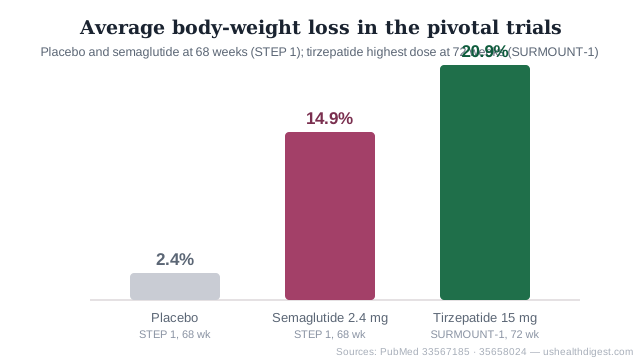
In the pivotal 68-week trial, adults taking weekly semaglutide 2.4 mg lost an average of 14.9% of their body weight, versus 2.4% on placebo — and roughly three-quarters of the participants were women. That is the honest headline number. Marketing pages promising faster or larger results are quoting hope, not the trial.
The trial the claims come from
Nearly every semaglutide weight-loss claim traces back to STEP 1, a randomized, double-blind, placebo-controlled trial of 1,961 adults with overweight or obesity, published in the New England Journal of Medicine (NEJMoa2032183). Key facts:
- Average loss: 14.9% of body weight over 68 weeks (about 16 months), against 2.4% for placebo — both groups also received lifestyle counselling.
- Most participants were women (roughly three in four), so this is one of the rare weight-loss evidence bases where the headline number is actually driven by female participants.
- Distribution matters: about a third of participants lost 20% or more, while some lost far less — "average" is not a guarantee.
- The timeline is long. The 14.9% figure is at 68 weeks. Weight loss is fastest in the early months and plateaus; no trial supports compressing these results into "by summer."
How the 68 weeks actually unfold
A detail that rarely survives the trip from journal article to ad copy: nobody in STEP 1 started on the full 2.4 mg dose. Semaglutide is titrated — you begin at a deliberately low dose and step up in stages over the first several months, giving the gastrointestinal system time to adapt before reaching the maintenance dose. That escalation period is where most of the nausea shows up, and it is also why the early weeks on the scale can look underwhelming compared with what the headline number seems to promise. You are not yet taking the dose that produced the headline number.
Once participants reached the full dose, the trajectory followed a familiar shape: the steepest losses came through the early and middle months, then the curve flattened. By the later stretch of the trial, average weight was roughly stable — the plateau. Two things are worth internalizing about that shape before you start:
- The plateau is the expected outcome, not a malfunction. The 14.9% average includes the flat months at the end. A prescriber who frames the plateau as "the medication stopped working" is misreading the trial it came from; a marketer who implies the early rate of loss continues indefinitely is doing something worse.
- Judging the drug in month two is premature in both directions. Slow early loss during titration doesn't mean you're a non-responder, and rapid early loss doesn't extrapolate to the finish line. The trial's endpoint was 68 weeks for a reason.
Practically, this means the honest mental model is a slow ramp, a productive middle, and a long flat maintenance phase — measured in months and quarters, not weeks. Any program that sells the first phase as the whole story is selling the wrong chart.
What 14.9% means at different starting weights
Percentages are abstract; bathroom scales are not. Here is the trial's average loss — 14.9% — applied to a few starting weights. To be completely clear about what this is: simple arithmetic on the trial average, shown as an illustration. It is not a prediction for any individual, and as noted above, individual results in STEP 1 ranged from far below this to well above it.
- Starting at 180 lb: 14.9% is about 27 lb, landing near 153 lb.
- Starting at 200 lb: about 30 lb, landing near 170 lb.
- Starting at 220 lb: about 33 lb, landing near 187 lb.
- Starting at 250 lb: about 37 lb, landing near 213 lb.
For contrast, the placebo group's 2.4% average — with the same lifestyle counselling — works out to roughly 5 lb for a 200 lb starting weight. That gap, about 30 lb versus about 5 lb over 16 months, is the entire evidence-based case for the medication in two numbers.
The distribution cuts both ways. Since about a third of participants lost 20% or more, a meaningful minority of a 200 lb starting weight lost upward of 40 lb — and an equally real group lost much less than the average. When a telehealth ad shows you its best before-and-after, it is showing you the right-hand tail of this distribution, not the middle.
What women specifically should know
- Side effects are common and mostly gastrointestinal. In STEP 1, nausea and diarrhea were the most frequent adverse events — typically transient and mild-to-moderate, but 4.5% of the semaglutide group discontinued due to gastrointestinal events, versus 0.8% on placebo. That is not rare, and it is worth planning for rather than discovering. (Our side-effects guide for women covers management in detail.)
- Pregnancy is a hard stop. GLP-1 medications are not for use during pregnancy or while trying to conceive; clinicians advise stopping in advance. Any legitimate prescriber will screen for this. Given that the evidence base skews heavily female and largely of reproductive age, this deserves more prominence than the fine print it usually gets.
- Eating much less means protein needs attention. These medications work substantially by suppressing appetite, and when total intake drops, protein intake tends to drop with it. Protein is the raw material for maintaining muscle, and preserving lean mass during rapid weight loss is a real concern — MedlinePlus's overview of dietary protein is a sensible neutral starting point, and a prescriber or dietitian can translate it into a target for your situation. Resistance exercise belongs in the same conversation.
- Weight returns if you stop. Follow-up studies consistently show substantial regain after discontinuation — this is chronic-disease management, not a course of antibiotics. Budget accordingly before starting, because the ongoing cost is part of the medical decision. More on this below.
What happens when you stop
This deserves its own section because it is the single most under-disclosed fact in GLP-1 marketing. The clearest evidence comes from a randomized withdrawal study in the same drug class: SURMOUNT-4, in which everyone took tirzepatide long enough to lose substantial weight, and then half were switched — blindly — to placebo. The two groups promptly diverged. Those who kept taking the medication continued to do well; those switched to placebo regained a substantial portion of the weight they had lost. Same people, same lifestyle counselling, one variable changed.
The mechanism is not mysterious. These medications suppress appetite while you take them; they do not renegotiate your biology permanently. Stop the drug and the appetite comes back, and with it, over time, much of the weight. That has three practical consequences worth sitting with before the first injection:
- The realistic planning horizon is years, not months. If the monthly cost is only sustainable for a six-month sprint, the trial evidence suggests you are budgeting for a round trip.
- An exit strategy is a legitimate medical conversation. Some prescribers discuss dose tapering and intensive lifestyle support for patients who need to stop — the evidence on how well that preserves results is thin, and anyone who claims otherwise is ahead of the data.
- Regain is not personal failure. It is the documented, randomized, placebo-controlled expected outcome of discontinuation. Plan around it instead of being ambushed by it.
We cover the withdrawal evidence and the practical options in more depth in our guide to stopping GLP-1s and weight regain.
The other STEP trials in one paragraph
STEP 1 is the headline act, but it is one trial in a larger program. The STEP series spans multiple randomized trials testing semaglutide 2.4 mg in different populations and settings — people with type 2 diabetes, longer treatment durations, maintenance after an initial run-in, more intensive behavioral therapy alongside the drug, and cohorts in different regions. We are deliberately not quoting numbers from those trials here, because each has its own population, duration and comparator, and cherry-picking a figure from one to sweeten the pitch is exactly the move this article exists to call out. The qualitative summary is what matters for a first read: across the program, the direction of the results is consistent — semaglutide produces substantially more weight loss than placebo, the gastrointestinal side-effect profile repeats, and the loss-then-plateau shape recurs. If a marketer quotes you a semaglutide number that is not 14.9%, ask which trial, which population and which week it comes from. If they can't answer, you have learned something more useful than the number.
What about tirzepatide?
Semaglutide is no longer the only medication in this space, and the comparison is where a lot of marketing sleight-of-hand happens. Tirzepatide's own pivotal trial, SURMOUNT-1, reported an average loss of 20.9% at the highest dose over 72 weeks — the tallest bar in our chart above. For years the honest caveat was that comparing that figure with STEP 1's 14.9% meant comparing two different trials with different participants, which is statistically treacherous. That caveat has since been partly retired: a randomized head-to-head trial directly comparing the two medications found that tirzepatide produced greater average weight loss than semaglutide in the same population. We'll leave the head-to-head figures to the paper itself, but the direction is no longer in dispute.
What that does not settle: which drug is right for a given woman. Availability, insurance coverage, out-of-pocket cost, side-effect tolerance and prescriber familiarity all differ, and "the drug with the bigger average" is not automatically "the drug you should take." For the full comparison — including the trade-offs the bigger number obscures — see our Wegovy vs Zepbound guide for women, and for what either one costs without coverage, our 2026 cost breakdown.
How this compares to what ads promise
Telehealth marketing routinely translates these trials into lines like "lose 15–25% of your body weight fast." The 15% end is defensible at 68 weeks; "fast" is not, and the 25% end reflects the best responders on the strongest alternative medication, not the average semaglutide patient. The FTC's Gut Check guide exists precisely because weight-loss advertising is the most reliably exaggerated category in consumer health. Our rule of thumb: any program quoting results without naming the trial is quoting marketing.
Questions to bring to your prescriber
A good prescribing conversation is longer than a telehealth intake form. These are the questions worth asking before the first prescription — and the quality of the answers is itself a screen for the quality of the prescriber.
- Am I a reasonable candidate at all? What in my history — thyroid, pancreas, gallbladder, GI conditions, eating-disorder history — changes the calculus for me specifically?
- What's the titration plan? How long until I reach the full dose, what should the early months feel like, and what symptoms mean "call me" rather than "ride it out"?
- What are we doing about pregnancy? If I'm of reproductive age: what contraception plan accompanies this, and how far in advance of trying to conceive would I need to stop?
- How will we protect muscle? What protein target and what resistance-exercise plan should run alongside the medication, and will anyone actually follow up on it?
- What does the plateau plan look like? When the loss flattens — as the trial says it will — what happens? Dose review, maintenance framing, or a hard sell to switch drugs?
- What's the exit strategy? If cost, side effects or pregnancy forces a stop, what does the evidence say I should expect, and what support exists for that phase?
- What will this cost over a realistic horizon? Not per month — over the years-long timeline the evidence actually describes, including what happens if insurance coverage changes.
- Which trial are your numbers from? If a program quotes you a result, ask for the study. A prescriber who can name it is quoting evidence; one who can't is quoting a landing page.
None of these questions is adversarial. A clinician running a legitimate practice will have ready answers to all of them; a pill mill will have answers to none. For a broader set of questions and answers, our GLP-1 FAQ for women goes through the list one by one.
Considering it?
If the trial numbers fit your goals, the next questions are practical: branded vs compounded medication (see our 2026 regulatory explainer — the difference now matters legally, not just financially), and which telehealth program's oversight you're comfortable with (our program comparison for women covers seven, including the trade-offs the cheap ones don't advertise). For the full question-by-question rundown: the GLP-1 FAQ for women.
- Wilding et al., Once-Weekly Semaglutide in Adults with Overweight or Obesity (STEP 1), NEJM 2021 — PubMed
- STEP 1 full text, New England Journal of Medicine
- FTC, Gut Check: A Reference Guide for Spotting False Weight Loss Claims
- Jastreboff et al., Tirzepatide Once Weekly for the Treatment of Obesity (SURMOUNT-1), NEJM 2022 — PubMed
- Aronne et al., Continued Treatment With Tirzepatide vs Switch to Placebo (SURMOUNT-4), JAMA 2024 — PubMed
- Randomized head-to-head trial of tirzepatide vs semaglutide in obesity — PubMed
- MedlinePlus, Protein in diet