
News & Trends
Semaglutide and sudden vision loss: what the NAION evidence actually shows
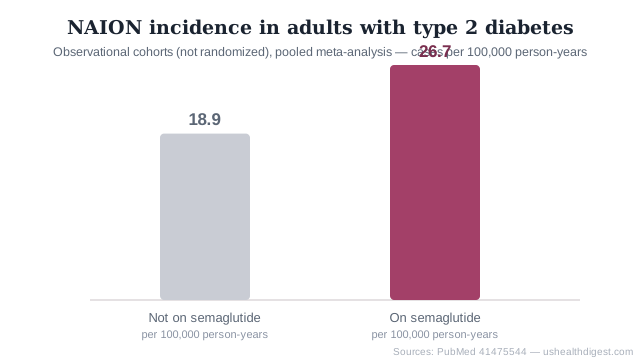
A 2026 meta-analysis in Ophthalmology is behind this week's headlines linking semaglutide (Ozempic, Rybelsus, Wegovy) to a rare optic-nerve condition called NAION. Pooled observational data in adults with type 2 diabetes found 26.7 cases per 100,000 person-years on semaglutide versus 18.9 without it — an association the randomized trials were too small to confirm or rule out. European regulators concluded in June 2025 that NAION is a "very rare" side effect: roughly a two-fold relative increase in people with type 2 diabetes, translating to about one additional case per 10,000 person-years of treatment. The practical guidance is unchanged and simple: do not stop the drug on your own; if you have sudden vision loss or rapidly worsening eyesight, contact a doctor without delay.
What NAION is, and who gets it
Non-arteritic anterior ischemic optic neuropathy — NAION — is a sudden reduction in blood flow to the front of the optic nerve. It typically causes rapid, painless, partial vision loss in one eye, and the damage is often permanent: the World Health Organization's June 2025 alert describes the vision loss as generally irreversible, with no effective treatment currently available. It is rare in the general population, and it existed long before GLP-1 drugs did — it occurs mostly in older adults and clusters with vascular conditions. The 2024 study that first raised this question matched patients on hypertension, type 2 diabetes, obstructive sleep apnea, obesity, hyperlipidemia, and coronary artery disease precisely because those conditions travel with NAION risk.
Semaglutide, for context, is prescribed at scale: in the pivotal STEP 1 trial, adults with overweight or obesity lost an average of 14.9% of body weight over 68 weeks versus 2.4% on placebo, and 74.1% of the 1,961 participants were women — one reason we track this class closely in our reporting on what the trials report about side effects and real-world semaglutide results.
What the new meta-analysis found
The news peg is a systematic review and meta-analysis published in Ophthalmology (May 2026 issue, online December 2025) that pooled 8 randomized controlled trials covering 31,174 patients and 8 observational studies covering 1,611,278 patients. Its four headline estimates point in the same general direction but differ sharply in how much confidence they deserve:
| Population and evidence type | Effect estimate | 95% confidence interval | Statistically significant? |
|---|---|---|---|
| Type 2 diabetes — observational | HR 1.85 | 1.20–2.85 | Yes |
| Type 2 diabetes — randomized trials | RR 1.76 (5 events vs 1) | 0.43–7.25 | No |
| Weight loss — observational | HR 1.57 | 0.69–3.59 | No |
| Weight loss — randomized trials | RR 2.18 (4 events vs 1) | 0.33–14.34 | No |
All figures are from the published abstract. A confidence interval that "crosses 1" means the data are statistically compatible with anything inside that range — including no effect at all, or even a protective one. The randomized-trial interval of 0.43 to 7.25 in diabetes, for example, is consistent with semaglutide halving NAION risk, leaving it unchanged, or multiplying it seven-fold; six total events across the randomized diabetes trials simply cannot distinguish between those possibilities. So the honest summary is: the association is clearest in observational data from people with diabetes, where it reached statistical significance, while the randomized evidence — the kind that can establish cause — is too sparse to confirm or exclude an effect. We say "associated with" rather than "causes" throughout because observational studies cannot fully separate the drug from the characteristics of the people prescribed it, who tend to have more diabetes, vascular disease, and sleep apnea than people who are not.
Why the 2024 study's numbers were so much larger
The study that started the inquiry, published in JAMA Ophthalmology in August 2024, reported far bigger effects: a 36-month cumulative incidence of 8.9% versus 1.8% in patients with type 2 diabetes (hazard ratio 4.28, 95% CI 1.62–11.29) and 6.7% versus 0.8% in patients with overweight or obesity (hazard ratio 7.64, 95% CI 2.21–26.36).
Those percentages are not population risks, and reading them that way is the single biggest error circulating in this story. The cohort came from patients evaluated by neuro-ophthalmologists at one academic center — people who were already being seen for eye and optic-nerve problems, a group enriched for exactly the disease being counted. In that highly selected setting, baseline NAION rates run orders of magnitude above the general population's. When later, larger analyses looked at broad populations — the observational cohorts pooled in the 2026 meta-analysis span more than 1.6 million patients — the absolute rates fell to the tens-of-cases-per-100,000-person-years range and the adjusted relative increase shrank to roughly 1.9-fold (HR 1.85). That pattern — a dramatic first signal from a specialized clinic, followed by smaller effects in general populations — is common in drug-safety research, and it is why single-center findings prompt investigations rather than conclusions.
What regulators decided — and what US labeling says
The European Medicines Agency's Pharmacovigilance Risk Assessment Committee (PRAC) reviewed the evidence and concluded on June 6, 2025 that NAION is a side effect of semaglutide with a frequency of "very rare" — the EU category meaning it may affect up to 1 in 10,000 people. PRAC recommended that the product information for Ozempic, Rybelsus, and Wegovy be updated to list it. Its advice: patients with sudden vision loss or rapidly worsening eyesight during treatment should contact their doctor without delay, and if NAION is confirmed, semaglutide should be stopped. The WHO echoed that guidance on June 27, 2025, and its advisory committee said semaglutide's risk-management plan should be revised to include NAION as a potential risk.
On the US side, we could not confirm that FDA has made an equivalent change to semaglutide prescribing information as of publication, and we are not going to claim one. What does exist is FDA's MedWatch program, where patients and clinicians can and should report suspected side effects, including vision changes. One related caution: compounded semaglutide products carry none of the approved labeling through which safety updates like Europe's reach patients, and FDA has logged 990 adverse event reports involving compounded semaglutide and more than 730 involving compounded tirzepatide as of May 31, 2026. We cover the distinction in detail in compounded versus branded GLP-1s, and the rulemaking that may end large-scale compounding in our news coverage.
How to think about the absolute risk
The most useful number in this entire story is EMA's: approximately one additional case of NAION per 10,000 person-years of treatment in adults with type 2 diabetes. A person-year is one person taking the drug for one year — so 10,000 people treated for a year, or 5,000 people treated for two years, add up to 10,000 person-years. Concretely: if 10,000 adults with type 2 diabetes take semaglutide for a year, roughly two would be expected to develop NAION based on the pooled background rate of 18.9 per 100,000 person-years, versus roughly three on treatment — about one extra case, and 9,997 or so people unaffected either way. A doubled relative risk sounds large; applied to a very rare condition, it stays very rare. That does not make the risk zero, and NAION's irreversibility is what earns it a label change. But it is the correct scale for a decision that also involves the drug's documented benefits.
Symptoms that warrant urgent contact with a clinician
Both EMA and WHO give the same instruction: contact your doctor without delay if, while taking semaglutide, you experience:
- Sudden loss of vision, typically painless and in one eye
- Rapidly worsening eyesight
Do not wait to see whether it resolves. NAION is a clinical diagnosis made by an eye specialist, and per EMA's guidance, semaglutide should be stopped only if NAION is actually confirmed.
Questions worth asking your prescriber
- Do I have conditions associated with NAION — the 2024 study matched patients on hypertension, type 2 diabetes, obstructive sleep apnea, obesity, hyperlipidemia, and coronary artery disease — and how do they change my personal calculus?
- How does a roughly one-in-10,000-per-year additional risk compare with what this medication is doing for my blood sugar, weight, or cardiovascular risk?
- Should I have a baseline eye exam, given my history?
- What exactly should I do — and whom should I call — if I notice sudden vision change?
More prescriber-conversation starters, including for oral GLP-1 formulations, are in our GLP-1 FAQ hub.
What this does not mean
It does not mean you should stop semaglutide on your own. No regulator has recommended that people without a confirmed diagnosis discontinue; EMA's advice is to stop only if NAION is confirmed, and stopping a diabetes medication abruptly carries risks of its own. It also does not mean the signal is noise. A significant association in pooled data from over 1.6 million patients, judged solid enough by European regulators to change product labeling, is a real finding about a rare but serious and largely irreversible condition. Both readings — panic and dismissal — get the story wrong. The accurate version is quieter: a very rare risk, now documented, that changes what patients should watch for more than it changes who should be treated.
Sources
- Liu et al. Rate and Risk of Nonarteritic Anterior Ischemic Optic Neuropathy with Semaglutide Use for Diabetes and Weight Loss: A Systematic Review and Meta-Analysis. Ophthalmology, May 2026 (epub Dec 29, 2025). pubmed.ncbi.nlm.nih.gov/41475544
- Hathaway et al. Risk of Nonarteritic Anterior Ischemic Optic Neuropathy in Patients Prescribed Semaglutide. JAMA Ophthalmology, August 1, 2024. pubmed.ncbi.nlm.nih.gov/38958939
- European Medicines Agency. PRAC concludes eye condition NAION is a very rare side effect of semaglutide medicines Ozempic, Rybelsus and Wegovy. EMA, June 6, 2025. ema.europa.eu/…/prac-concludes-eye-condition-naion
- World Health Organization. Medical product alert: semaglutide medicines and NAION. WHO, June 27, 2025. who.int/news/…/semaglutide-medicines-naion
- US Food and Drug Administration. MedWatch: The FDA Safety Information and Adverse Event Reporting Program. FDA. fda.gov/safety/medwatch
- ClinicalTrials.gov. Semaglutide 2.4 mg in Adults with Overweight or Obesity (STEP 1), NCT03548935 — baseline characteristics: 1,453 of 1,961 participants (74.1%) female. clinicaltrials.gov/study/NCT03548935
- Wilding et al. Once-Weekly Semaglutide in Adults with Overweight or Obesity (STEP 1). New England Journal of Medicine, March 18, 2021 (published online February 10, 2021). pubmed.ncbi.nlm.nih.gov/33567185
- US Food and Drug Administration. FDA's Concerns with Unapproved GLP-1 Drugs Used for Weight Loss. FDA, updated 2026. fda.gov/drugs/…/fdas-concerns-unapproved-glp-1-drugs