
News & Trends
GLP-1s are fast replacing surgery for teens and young adults with obesity — what the evidence can and cannot tell families
Medication has all but displaced surgery in the treatment of obesity among US adolescents and young adults, according to a study published July 20 in JAMA Pediatrics. Among 204,148 patients aged 13 to 25 treated for obesity in the Epic Cosmos health-records database between May 2022 and January 2026, the share treated exclusively with a GLP-1 receptor agonist rose from 88.2% to 96.1%, while metabolic and bariatric surgery fell from 11.6% to 3.7%. The UT Southwestern researchers say the findings "highlight the need for evidence-based guidance on treatment sequencing and long-term outcomes" — a careful way of saying practice has moved faster than the evidence. For a parent weighing treatment for an adolescent, the honest state of play is: solid 68-week trial data, an FDA-approved option from age 12, and no data at all on what decades of use begun in the teens will mean.
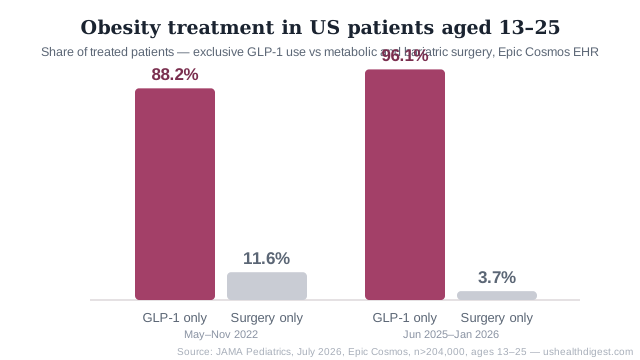
What the new study measured
The research letter, led by epidemiologist Sarah Messiah, PhD, MPH, of UT Southwestern Medical Center, drew on Epic Cosmos, an electronic health-record database representing more than 300 million US patients. It counted adolescents and young adults aged 13 to 25 who received one of the two major medical treatments for obesity — a GLP-1 receptor agonist, metabolic and bariatric surgery, or both — and tracked how that mix shifted across the study window.
| Treatment received | May–Nov 2022 | Jun 2025–Jan 2026 |
|---|---|---|
| GLP-1 receptor agonist only | 88.2% | 96.1% |
| Metabolic and bariatric surgery only | 11.6% | 3.7% |
| Both GLP-1 and surgery | 0.2% | 0.2% |
All figures are from the published study. Two cautions before reading anything more into them. First, these are shares of treated patients — the study does not say how many young people with obesity get any treatment at all. Second, the authors are explicit that the data cannot explain the surgery decline: "We could not determine from these data whether the decline in MBS was associated with substitution by pharmacotherapy, differences in insurance coverage, changes in referral practices, or evolving patient preferences." Messiah, in UT Southwestern's announcement, called the study a capture of "an inflection point in pediatric obesity treatment." Inflection points are exactly the moments when families most need to know what is proven and what is not.
What the trial evidence in adolescents actually shows
The pivotal randomized trial of semaglutide in adolescents is STEP TEENS, published in the New England Journal of Medicine in 2022. It enrolled 201 adolescents aged 12 to under 18, randomized to weekly semaglutide 2.4 mg or placebo for 68 weeks. The results were strong: mean BMI fell 16.1% with semaglutide versus a 0.6% rise with placebo, and 73% of semaglutide-treated adolescents lost at least 5% of body weight versus 18% on placebo. That is comparable to — in BMI terms, somewhat larger than — the adult benchmark from STEP 1, where adults lost an average of 14.9% of body weight over 68 weeks versus 2.4% on placebo.
What 68 weeks can and cannot establish
A 68-week trial can establish that the drug works over 68 weeks and characterize its common side effects over that period. It cannot say what happens over five, ten, or thirty years — and for a 13-year-old, that is the relevant horizon, because obesity medication in current practice is long-term therapy. The clearest evidence on that point comes from adults: in the SURMOUNT-4 trial, adults who stopped tirzepatide after an initial treatment period regained a substantial share of the weight they had lost, while those who continued kept losing. We cover that dynamic in detail in what happens when you stop a GLP-1; there is no adolescent equivalent of that data yet.
What is approved for adolescents — and since when
Wegovy, the 2.4 mg weight-management formulation of semaglutide, is the option with an FDA approval reaching down to age 12. FDA's approval record for the drug shows the pediatric extension was granted on December 23, 2022 — an efficacy supplement adding a new patient population, weeks after STEP TEENS was published. The current prescribing information covers "pediatric patients aged 12 years and older with obesity." The same label lists the most common adverse reactions in patients 12 and older: nausea, diarrhea, vomiting, constipation, abdominal pain, headache, dizziness, gastroesophageal reflux, and — a finding that lands differently for teenagers — hair loss. Our guide to GLP-1 side effects as reported in the trials covers management of the gastrointestinal effects, which are the dominant reason people reduce doses or stop.
Note what the JAMA Pediatrics cohort actually spans: ages 13 to 25. The younger end sits inside the pediatric approval; the older end is ordinary adult prescribing. The study does not break out how much of the growth came from the youngest patients.
The honest unknowns
These are not reasons to refuse treatment; they are the parts of the decision where evidence runs out and judgment begins.
- Duration. No one has data on GLP-1 use that begins at 13 and continues for decades, because the drugs have not been prescribed to adolescents at scale for long enough. The longest randomized adolescent evidence is measured in months, not years. The study authors themselves flag "long-term outcomes" as an open evidence need.
- Stopping. If adult patterns hold — and SURMOUNT-4 is the cleanest demonstration — discontinuation tends to mean regain. A family starting a 14-year-old on therapy should assume they are starting something open-ended, and plan (insurance included) accordingly.
- Puberty, growth, and fertility. STEP TEENS ran 68 weeks in 12-to-17-year-olds; the long-term effects of sustained GLP-1 exposure through puberty and into childbearing years have not been studied. What is documented: the Wegovy label instructs patients to discontinue the drug at least 2 months before a planned pregnancy, because of semaglutide's long half-life. For a girl starting at 13, that instruction will eventually be relevant — our explainer on GLP-1s, pregnancy, and fertility goes through the label evidence in detail.
- Sequencing. Whether a given adolescent is better served by medication first, surgery first, or medication after surgery is precisely the question the study's authors say lacks evidence-based guidance. The 0.2% combined-use figure suggests almost no one is currently getting a deliberately sequenced approach.
Questions to bring to a pediatrician
If your family is considering treatment, these questions map onto the actual evidence and its gaps:
- Does my child meet the criteria on the FDA label for their age, and have we tried or ruled out structured lifestyle treatment first?
- What is a realistic outcome? In the trial, 73% of adolescents lost at least 5% of body weight — meaning roughly a quarter did not reach even that threshold.
- How long do you expect my child to stay on this medication, and what is the plan — and the expected regain risk — if we stop?
- Which side effects should prompt a call, and how will you manage the common gastrointestinal ones?
- For daughters: how does this interact with contraception and future pregnancy planning, given the label's two-month pre-pregnancy washout?
- Will you monitor growth and pubertal development during treatment, and how often?
- Is a metabolic and bariatric surgery evaluation worth discussing in our case, or clearly not — and on what basis?
- If insurance coverage lapses, what happens to the treatment plan?
What this shift does not settle
A treatment pattern is not a verdict. The migration from 11.6% surgery to 3.7% in under four years could reflect genuinely better options reaching more kids, or coverage and referral dynamics steering families toward whatever is easiest to prescribe — the data cannot distinguish these, and the authors say so. What the study does establish is that American medicine has, within four years, largely committed a generation of young patients to a pharmacological path whose long-term consequences will only be known as that generation lives them. That is not an argument against treating adolescent obesity, which carries well-known risks of its own. It is an argument for treating the decision as a real one: made with a pediatrician, with the trial numbers on the table, and with the unknowns named out loud rather than assumed away.
Sources
- Messiah SE, et al. GLP-1 Receptor Agonist and Bariatric Surgery Utilization Among Adolescents and Young Adults. JAMA Pediatrics, July 20, 2026. doi:10.1001/jamapediatrics.2026.2828. jamanetwork.com/journals/jamapediatrics/fullarticle/2851775
- UT Southwestern Medical Center. Newsroom release on GLP-1 use in adolescents and young adults, July 2026. utsouthwestern.edu/newsroom/…/july-glp-1-adolescents
- Weghuber D, et al. Once-Weekly Semaglutide in Adolescents with Obesity (STEP TEENS). New England Journal of Medicine, December 15, 2022 (published online November 2, 2022). pubmed.ncbi.nlm.nih.gov/36322838
- US Food and Drug Administration. Drugs@FDA: Wegovy (semaglutide) NDA 215256 approval history — SUPPL-5, Efficacy-New Patient Population, approved December 23, 2022. accessdata.fda.gov/…/ApplNo=215256
- DailyMed (National Library of Medicine). WEGOVY (semaglutide) injection — current prescribing information. dailymed.nlm.nih.gov/dailymed/drugInfo.cfm?setid=ee06186f…
- Wilding JPH, et al. Once-Weekly Semaglutide in Adults with Overweight or Obesity (STEP 1). New England Journal of Medicine, March 18, 2021. pubmed.ncbi.nlm.nih.gov/33567185
- Aronne LJ, et al. Continued Treatment With Tirzepatide for Maintenance of Weight Reduction in Adults With Obesity (SURMOUNT-4). JAMA, 2024 (published online December 11, 2023). pubmed.ncbi.nlm.nih.gov/38078870