
News & Trends
The oral GLP-1 race: what the first pill-versus-pill trial actually showed — and why it was not a weight-loss trial
In ACHIEVE-3, the first phase 3 head-to-head of two GLP-1 pills, Eli Lilly's orforglipron beat Novo Nordisk's oral semaglutide on blood sugar and on weight — while producing more gastrointestinal side effects and roughly twice the rate of dropping out because of them. The trial randomized 1,698 adults with type 2 diabetes inadequately controlled on metformin to four arms for 52 weeks, and was published in The Lancet on February 26, 2026 — not this month. The framing most coverage skips: this was a diabetes trial, weight was a secondary endpoint, and the same GLP-1 at the same dose for the same duration has produced less weight loss in people with type 2 diabetes than in people without it — −14.9% in STEP 1 versus −9.6% in STEP 2. The 9.2% average loss on orforglipron's top dose (efficacy estimand, 52 weeks) is not a number a woman without diabetes should carry into a prescriber's office. The obesity trials are separate studies, kept separate below. Discontinuation due to adverse events was 9.7% on orforglipron 36 mg versus 4.9% on oral semaglutide 14 mg — arguably the most decision-relevant figure here.
Why you are reading about a February trial in July
A study recirculating is not the same as a study appearing. Lilly announced ACHIEVE-3's topline result in a news release dated September 17, 2025. The peer-reviewed paper went online in The Lancet on February 26, 2026 and appeared in the March 21 print issue. An Annals of Internal Medicine evidence appraisal followed in June 2026. Then Lilly said eligible Medicare Part D patients may be able to get Foundayo — orforglipron's brand name — for $50 per month, beginning as soon as July 1, 2026. A price change, not a new finding, is the likeliest reason the oral GLP-1 story is back in circulation this summer. Treat anything presented as breaking news about this trial with suspicion.
What ACHIEVE-3 compared
ACHIEVE-3 (NCT06045221) was a 52-week, open-label, randomized phase 3 trial at 131 centers in Argentina, China, Japan, Mexico and the United States. Participants had type 2 diabetes inadequately controlled on at least 1,500 mg of metformin daily, an A1c of 7.0–10.5% and a BMI of at least 25, and were assigned equally to orforglipron 12 mg or 36 mg, or oral semaglutide 7 mg or 14 mg. Baseline A1c was 8.3% and baseline weight 97.0 kg (213.9 lb). The primary objective was non-inferiority on A1c, with superiority tested only after non-inferiority was met; both orforglipron doses proved superior to both semaglutide doses, including the low orforglipron dose against the high semaglutide dose.
One technical point changes how the numbers read. The paper's primary analysis, which counts everyone randomized whether or not they stopped the drug, found A1c reductions of −1.71% and −1.91% on orforglipron 12 and 36 mg, versus −1.23% and −1.47% on semaglutide 7 and 14 mg. Lilly's release quotes the more flattering efficacy estimand, which models what would have happened had everyone stayed on treatment: −1.9% and −2.2% versus −1.1% and −1.4%. Both are legitimate answers to different questions, and the direction is the same either way.
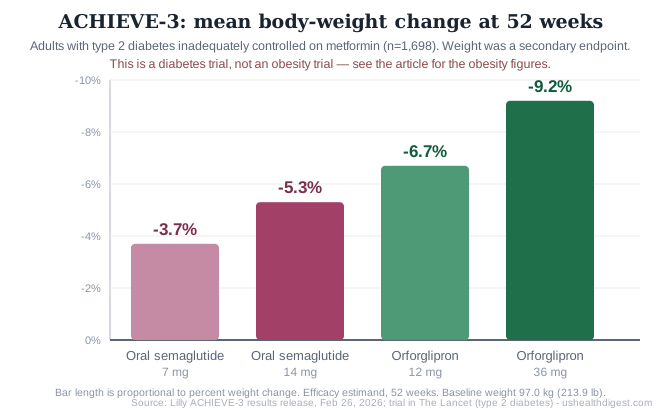
Why these weight numbers are not your numbers
Three separate reasons, each sufficient on its own.
- The population had diabetes. The cleanest like-for-like evidence comes from the semaglutide obesity program: same drug, same 2.4 mg weekly dose, same 68 weeks, and mean weight change of −14.9% in 1,961 adults without diabetes (STEP 1) against −9.6% in 1,210 adults with type 2 diabetes (STEP 2). Neither trial studied the drugs in ACHIEVE-3, so this is a documented pattern for the class rather than a measurement of orforglipron.
- The doses were diabetes doses. Oral semaglutide was given at 7 mg and 14 mg: the Rybelsus maintenance doses approved for glycemic control in type 2 diabetes, not the 25 mg tablet approved for weight management. ACHIEVE-3 never tested the weight-loss dose.
- Weight was secondary. The trial was designed and powered around A1c, and the weight figures Lilly published come from the efficacy estimand rather than the paper's primary one.
A fourth wrinkle: orforglipron is not FDA-approved for type 2 diabetes in the US at all. Its April 1, 2026 approval as Foundayo covers adults with obesity, or overweight with weight-related medical problems. The head-to-head behind these headlines was run in a population the winning drug is not licensed to treat here.
The obesity evidence, kept separate
Orforglipron — ATTAIN-1. A 72-week, double-blind, placebo-controlled phase 3 trial in 3,127 adults with obesity and without diabetes. Mean weight change at week 72 was −7.5% (6 mg), −8.4% (12 mg) and −11.2% (36 mg), versus −2.1% on placebo, under the treatment-regimen estimand. On the top dose, 54.6% lost at least 10% of body weight and 18.4% lost at least 20%.
Oral semaglutide 25 mg — OASIS 4. A double-blind, placebo-controlled trial in 307 adults with overweight or obesity and without diabetes, primary endpoint at week 64. Mean weight change was −13.6% versus −2.2% on placebo under the trial's primary estimand, which counts everyone randomized regardless of whether they stopped. Novo Nordisk's approval announcement instead quotes "16.6% mean weight loss when treatment was adhered to", which Novo attributes to the trial product estimand — the modelled effect had everyone adhered, a different question. The trial was also smaller than ATTAIN-1 by a factor of ten.
It is tempting to set 13.6% beside 11.2% and conclude the semaglutide pill is the stronger weight-loss drug. That conclusion is not supported: different trials, populations, durations, sample sizes and estimands are the exact conditions under which cross-trial comparison misleads. A drug can win a head-to-head in diabetes and still be the weaker obesity drug — or the stronger one. Only a head-to-head in obesity would settle it, and none has been published. Our guide to the two approved GLP-1 pills covers each trial in more detail.
The pills a US patient can actually be prescribed in 2026
| Pill | FDA-approved for | Doses | Pivotal weight evidence | Dosing conditions |
|---|---|---|---|---|
| Oral Wegovy (semaglutide 25 mg tablet) | Chronic weight management; in US pharmacies since early January 2026 | 25 mg once daily, reached by monthly escalation from a lower starting strength | OASIS 4: −13.6% vs −2.2% placebo at 64 weeks; n=307 adults with overweight or obesity and without diabetes; primary estimand | Peptide tablet; food and water conditions |
| Foundayo (orforglipron tablet) | Obesity, or overweight with weight-related medical problems (approved April 1, 2026). Not approved for type 2 diabetes | Tablets of 0.8, 2.5, 5.5, 9, 14.5 and 17.2 mg; started at 0.8 mg and escalated monthly to a maximum of 17.2 mg once daily. The 6/12/36 mg labels used in the trials are the research nomenclature, not the marketed strengths | ATTAIN-1: −11.2% at the top dose vs −2.1% placebo at 72 weeks; n=3,127 adults with obesity and without diabetes; treatment-regimen estimand | Any time of day, with or without food or water |
| Rybelsus (semaglutide 3/7/14 mg tablet) | Type 2 diabetes: glycemic control, and cardiovascular risk reduction in high-risk patients. Not a weight-management approval | 7 or 14 mg maintenance | None in obesity; these are the doses used in ACHIEVE-3 | Peptide tablet; food and water conditions |
Each row cites a different trial with its own population, duration and statistical design; the rows are not comparable to one another.
How the pills sit against the injections
Convenience, not potency, is the honest argument for a pill. The injectable benchmarks remain higher: in STEP 1, 1,961 adults with overweight or obesity and without diabetes lost an average of 14.9% of body weight over 68 weeks on weekly semaglutide 2.4 mg, versus 2.4% on placebo. In SURMOUNT-1, 2,539 similar adults lost up to 20.9% over 72 weeks on tirzepatide 15 mg, versus 3.1% on placebo. Separate trials again, so the same cross-trial caution applies: no oral trial has yet reported a figure in SURMOUNT-1's range, but that ordering is suggestive rather than measured. We compare the leading injectables in Wegovy vs Zepbound for women, and what semaglutide trials show in women in semaglutide results for women.
Tolerability: the trade-off the headlines bury
ACHIEVE-3 did not show a free lunch. Gastrointestinal adverse events occurred in 59% of the orforglipron 12 mg group and 58% of the 36 mg group, versus 37% and 45% of the semaglutide 7 mg and 14 mg groups. Most were mild to moderate. But more participants stopped treatment because of side effects on orforglipron — 37 of 424 on 12 mg and 41 of 423 on 36 mg, against 19 of 426 and 21 of 425 on semaglutide, or 8.7% and 9.7% versus 4.5% and 4.9%. Mean pulse rate also rose more on orforglipron (3.7 and 4.7 bpm versus 1.0 and 1.5 bpm). The most common adverse events across arms were nausea, diarrhea, vomiting, dyspepsia and decreased appetite. Four deaths occurred: one in each orforglipron group, two in the semaglutide 7 mg group.
Two caveats cut in opposite directions. The trial was open-label — participants and investigators knew which drug they were taking, which can influence how side effects are reported and how quickly someone quits. But the orforglipron discontinuation rate here matched its obesity trial, where adverse events ended treatment in 5.3% to 10.3% of orforglipron participants versus 2.7% on placebo. A medication only works while you are taking it, so a roughly doubled quit rate is not a footnote to the efficacy result; it is part of it. Our side-effect guide for women covers what is usually manageable during escalation and what warrants a call.
What to do with this
Questions worth bringing to a prescriber: Given my health history, is a pill preferable to an injectable — and on what grounds? Am I being offered an FDA-approved weight-management product, or a diabetes product used off-label? How will we handle nausea during escalation, and at what point would we change course rather than stop? What is the plan if coverage lapses?
That last question is not rhetorical: coverage, not trial data, determines what most patients take, and our 2026 GLP-1 insurance guide covers Medicare's bridge program and manufacturer direct-pay pricing. One warning is specific to pills. "Oral semaglutide" sold by compounders as kits, drops or troches is not the same thing as an FDA-approved tablet. The FDA states plainly that it "does not review compounded drugs for safety, effectiveness or quality before they are marketed", and as of May 31, 2026 it had received 990 adverse-event reports involving compounded semaglutide and more than 730 involving compounded tirzepatide. See our compounded versus branded comparison and our GLP-1 FAQ for women.
What ACHIEVE-3 established is narrow: in adults with type 2 diabetes on metformin, one pill lowered A1c and weight more than the other, at the cost of more nausea and more people quitting. What it did not establish is which pill a woman without diabetes should take for weight loss. On that question the evidence is still two separate trials, pointing in a direction nobody has tested directly.
Sources
- Rosenstock J, Yabe D, et al. Efficacy and safety of once-daily oral orforglipron compared with oral semaglutide in adults with type 2 diabetes (ACHIEVE-3). The Lancet, published online February 26, 2026; 2026 Mar 21;407(10534):1147–1160. doi:10.1016/S0140-6736(26)00202-3 — the peer-reviewed head-to-head trial. pubmed.ncbi.nlm.nih.gov/41765029
- Eli Lilly and Company. Detailed ACHIEVE-3 results release, February 26, 2026 — source for baseline characteristics, efficacy-estimand A1c and weight figures, and discontinuation rates. investor.lilly.com/…/lillys-oral-glp-1-orforglipron-delivered-superior-blood-sugar
- Eli Lilly and Company. Topline ACHIEVE-3 announcement, September 17, 2025 — establishes when the result was first disclosed. investor.lilly.com/…/lillys-oral-glp-1-orforglipron-superior-oral-semaglutide-head
- ACP Journal Club. In T2D inadequately controlled with metformin, orforglipron reduced HbA1c more than oral semaglutide at 52 wk. Annals of Internal Medicine, June 2026;179:JC62 — independent evidence appraisal of ACHIEVE-3. pubmed.ncbi.nlm.nih.gov/42224699
- Wharton S, Aronne LJ, et al. Orforglipron, an Oral Small-Molecule GLP-1 Receptor Agonist for Obesity Treatment (ATTAIN-1). NEJM 2025 Nov 6;393(18):1796–1806. pubmed.ncbi.nlm.nih.gov/40960239
- Wharton S, Lingvay I, et al. Oral Semaglutide at a Dose of 25 mg in Adults with Overweight or Obesity (OASIS 4). NEJM 2025 Sep 18;393(11):1077–1087. pubmed.ncbi.nlm.nih.gov/40934115
- Eli Lilly and Company. FDA approves Foundayo (orforglipron), April 1, 2026 — indication, dosing conditions, and July 1, 2026 Medicare Part D pricing. investor.lilly.com/…/fda-approves-lillys-foundayotm-orforglipron-only-glp-1-pill
- Novo Nordisk. Wegovy pill approved in the US as first oral GLP-1 for weight management, December 22, 2025 — the 16.6% figure and early-January 2026 US availability. novonordisk.com/news-and-media/…/id=916472
- DailyMed (National Library of Medicine). FOUNDAYO (orforglipron) tablets — prescribing information; source for the marketed tablet strengths, the escalation schedule and the 17.2 mg maximum dose. dailymed.nlm.nih.gov/dailymed/drugInfo.cfm?setid=8ac446c5…
- DailyMed (National Library of Medicine). RYBELSUS (oral semaglutide) tablets — prescribing information, indications and maintenance doses. dailymed.nlm.nih.gov/dailymed/drugInfo.cfm?setid=27f15fac…
- Wilding JPH, et al. Once-Weekly Semaglutide in Adults with Overweight or Obesity (STEP 1). NEJM 2021 Mar 18;384(11):989–1002 — −14.9% at 68 weeks in 1,961 adults without diabetes. pubmed.ncbi.nlm.nih.gov/33567185
- Davies M, et al. Semaglutide 2·4 mg once a week in adults with overweight or obesity, and type 2 diabetes (STEP 2). The Lancet 2021 Mar 13;397(10278):971–984 — −9.6% at 68 weeks in 1,210 adults with type 2 diabetes; the same drug, dose and duration as STEP 1, and the source for the statement that diabetes attenuates GLP-1 weight loss. pubmed.ncbi.nlm.nih.gov/33667417
- Jastreboff AM, et al. Tirzepatide Once Weekly for the Treatment of Obesity (SURMOUNT-1). NEJM 2022 Jul 21;387(3):205–216. pubmed.ncbi.nlm.nih.gov/35658024
- US Food and Drug Administration. FDA's Concerns with Unapproved GLP-1 Drugs Used for Weight Loss — adverse-event report counts as of May 31, 2026. fda.gov/drugs/drug-alerts-and-statements/fdas-concerns-unapproved-glp-1-drugs-used-weight-loss
- ClinicalTrials.gov. ACHIEVE-3 trial registration, NCT06045221. clinicaltrials.gov/study/NCT06045221
This article is general information, not medical advice; discuss any weight-loss medication decision with a licensed clinician who knows your health history.