
Weight & Metabolic Health
The GLP-1 Pill Era Is Here: Oral Wegovy vs Foundayo — and What the Online "Oral Kits" Are Not
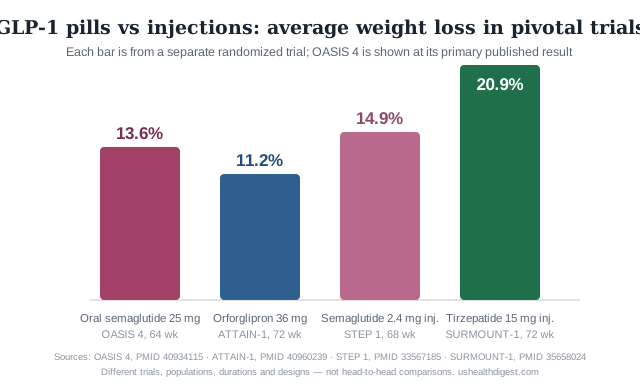
As of mid-2026, exactly two GLP-1 pills are FDA-approved for chronic weight management: oral Wegovy (semaglutide 25 mg tablets), in US pharmacies since early January 2026, and Foundayo (orforglipron), approved April 1, 2026. In separate pivotal trials that cannot be compared head-to-head, oral semaglutide averaged 13.6% body-weight loss at 64 weeks versus 2.2% on placebo (OASIS 4), and orforglipron's top dose averaged 11.2% at 72 weeks versus 2.1% on placebo (ATTAIN-1) — each trial's primary published result. The "oral semaglutide kits," drops, and troches sold online are not FDA-approved, and the FDA warns it has not reviewed them for safety, effectiveness, or quality.
Two approved GLP-1 pills now exist — and they are different drugs
GLP-1 weight-loss medication used to mean a weekly injection. That changed twice within months. First, the FDA approved Wegovy (semaglutide) 25 mg tablets for chronic weight management — the first oral GLP-1 approved for obesity — with US pharmacy availability in early January 2026, per Novo Nordisk's announcement and AJMC's coverage. It is the same peptide as injectable Wegovy, reformulated as a once-daily tablet — which is why it carries dosing conditions around food and water.
Then, on April 1, 2026, the FDA approved Eli Lilly's Foundayo (orforglipron), the first small-molecule (non-peptide) oral GLP-1 for obesity. Because it is not a peptide, it can be taken any time of day without food or water restrictions, per Lilly's approval announcement.
What the pivotal trials actually found
Oral semaglutide 25 mg: the OASIS 4 trial
OASIS 4, published in the New England Journal of Medicine in September 2025 (Wharton S, et al.), randomized 307 adults with overweight or obesity and without diabetes — 205 to oral semaglutide 25 mg once daily and 102 to placebo, 242 of the 307 participants (78.8%) were women, which makes the results unusually representative for this readership. The trial's primary result: estimated mean body-weight change from baseline to week 64 was −13.6% on oral semaglutide versus −2.2% on placebo, an estimated difference of −11.4 percentage points (95% CI −13.9 to −9.0, P<0.001). Gastrointestinal adverse events were more common on the drug than on placebo, 74.0% versus 42.2%.
You will also see a larger number quoted. Novo Nordisk's approval announcement cites "16.6% mean weight loss when treatment was adhered to", which the company footnotes to the trial product estimand. Both figures come from the same trial; they answer different questions.
What an "estimand" is, in plain English. An estimand is the question a trial's number is the answer to. Two are in play here:
- The treatment-policy estimand — OASIS 4's primary analysis, and the source of the −13.6% figure — counts every person who was randomized, using their weight at week 64 whether or not they were still taking the drug and whether or not they added another weight-loss treatment. It answers: what happens, on average, to people who are started on this drug? That includes the ones for whom it did not work out.
- The trial product estimand — the source of Novo's 16.6% — statistically models what the average would have been if everyone had taken the drug as directed for the full trial and nobody had added rescue therapy. It answers: how well does the molecule work when it is actually taken?
Neither is a trick; regulators ask for both. But the first is the one that describes a real-world starting decision, which is why it is the trial's primary endpoint and the figure we lead with. The trial product estimand is systematically the larger of the two, so it is the one that tends to show up in marketing — and Novo's release publishes no placebo comparator alongside its 16.6%, meaning that figure cannot be converted into a drug-versus-placebo difference. A peer-reviewed review of the OASIS program covers the trial series in more detail.
Orforglipron: the ATTAIN-1 trial
ATTAIN-1, also published in NEJM in September 2025 (Wharton S, Aronne LJ, et al.), was roughly ten times larger: 3,127 adults with obesity and without diabetes. At 72 weeks, mean weight change was −7.5% on the 6 mg dose, −8.4% on 12 mg, and −11.2% on 36 mg, versus −2.1% on placebo. That is the treatment-regimen estimand — ATTAIN-1's primary analysis, and the same kind of question OASIS 4's primary analysis answers: it uses data from everyone randomized, regardless of what happened afterward.
The responder figures come from the same estimand, so they can be quoted alongside the mean without mixing frames. On the 36 mg dose, 54.6% of participants lost at least 10% of body weight, 36.0% lost at least 15%, and 18.4% lost at least 20% — against 12.9%, 5.9% and 2.8% respectively on placebo. Lilly's press release quotes higher numbers throughout — a mean of −12.4% and 59.6% reaching 10% — drawn from the efficacy estimand, the company's counterpart to Novo's trial product figure. Both sets are real; the mistake is quoting one trial's mean beside the other's responder rate. We use the peer-reviewed primary analysis throughout so that every figure on this page describes the same population.
Set side by side, 13.6% looks larger than 11.2% — but these are different trials with different populations, sample sizes (307 vs 3,127) and durations (64 vs 72 weeks), and they cannot be read as a head-to-head comparison. No published trial has directly compared the two pills in weight loss, so "which pill produces more weight loss" currently has no evidence-based answer. The one head-to-head that exists, ACHIEVE-3, was run in adults with type 2 diabetes — we unpack it in what the first pill-versus-pill trial actually showed.
How the pills sit alongside the injections
The injectable benchmarks are well established: semaglutide 2.4 mg averaged 14.9% weight loss at 68 weeks in STEP 1 (Wilding JPH, et al., NEJM 2021), and tirzepatide averaged up to 20.9% at 72 weeks on the highest dose in SURMOUNT-1 (Jastreboff AM, et al., NEJM 2022). The only published head-to-head among any of these drugs remains SURMOUNT-5, in which injectable tirzepatide beat injectable semaglutide over 72 weeks (NEJM 2025) — unpacked in our Wegovy vs Zepbound guide for women.
| Medication | FDA approval (obesity) | Dosing | Pivotal trial result | Practical restrictions |
|---|---|---|---|---|
| Oral Wegovy (semaglutide 25 mg tablet) | Late 2025; in US pharmacies early January 2026 | One tablet daily | −13.6% vs −2.2% placebo at 64 weeks (OASIS 4, primary treatment-policy estimand; n=307) | Peptide tablet with dosing conditions around food and water intake |
| Foundayo (orforglipron tablet) | April 1, 2026 | One tablet daily (6, 12, or 36 mg studied) | −7.5% / −8.4% / −11.2% by dose vs −2.1% placebo at 72 weeks (ATTAIN-1, primary treatment-regimen estimand; n=3,127) | Any time of day; no food or water restrictions |
| Injectable Wegovy (semaglutide 2.4 mg) | 2021 | Weekly injection | 14.9% avg loss vs 2.4% placebo at 68 weeks (STEP 1) | Injection; refrigerated storage |
| Injectable Zepbound (tirzepatide) | 2023 | Weekly injection | Up to 20.9% avg loss at highest dose vs placebo at 72 weeks (SURMOUNT-1) | Injection; refrigerated storage |
Each row cites a different trial with its own population, duration, and statistical design; the numbers are not directly comparable across rows. SURMOUNT-5 is the only head-to-head trial among these drugs, and it compared the two injectables only.
What the trial averages translate to: a worked example
Percentages feel abstract, so here is the arithmetic — with the caveat that these are trial averages, not predictions for any individual; results in every trial ranged widely in both directions.
Take a woman starting at 200 lb, and use each trial's primary result — the analysis that counts everyone randomized, not just those who stayed on the drug.
- OASIS 4, oral semaglutide 25 mg, 64 weeks. A 13.6% mean loss is 27.2 lb, landing at about 173 lb. The placebo group's 2.2% is 4.4 lb, landing at about 196 lb. The trial's estimated difference of 11.4 percentage points is 22.8 lb — the portion attributable to the drug rather than to the lifestyle program both groups received.
- ATTAIN-1, orforglipron 36 mg, 72 weeks. An 11.2% mean loss is 22.4 lb, landing at about 178 lb, against 2.1% — 4.2 lb — on placebo, a gap of 9.1 percentage points or 18.2 lb.
- The responder view. On orforglipron 36 mg, 54.6% of participants lost at least 10% of body weight, which on a 200-lb frame is at least 20 lb. The other side of that same number is that 45.4% — nearly half — did not reach it. On placebo, 12.9% did.
Note what the placebo columns are doing: they are not zero. Everyone in both trials also got a structured diet-and-activity program, so a few pounds of the average belong to that, not to the tablet.
Two more evidence-based expectations belong in the calculation. These are treatments for a chronic condition: in SURMOUNT-4, participants who stopped tirzepatide regained a substantial portion of the weight lost (Aronne LJ, et al., 2023) — our guide to what happens when you stop a GLP-1 goes deeper. And gastrointestinal side effects remain the dominant tolerability issue across the class; see our side-effect guide for women before assuming a pill will be gentler than an injection.
Practical differences that may matter more than the percentages
For many women, the deciding factors will be logistical rather than statistical:
- Dosing conditions. Oral semaglutide is a peptide and carries conditions on how the tablet is taken relative to food and water; orforglipron, as a small molecule, can be taken any time of day with no food or water restrictions, per Lilly's approval announcement.
- No needles, no refrigeration. Both pills remove the injection and cold-storage logistics of the weekly injectables.
- Coverage. Insurance, not trial data, decides what most patients actually take. Medicare's new GLP-1 Bridge program covers both approved pills — our 2026 GLP-1 insurance coverage guide walks through it and the manufacturer direct-pay options.
- Pregnancy. Neither pill should be used during pregnancy or while trying to conceive. A legitimate prescriber will ask; see our GLP-1 FAQ for women.
What the "oral semaglutide kits" sold online are not
The arrival of legitimate GLP-1 pills has energized a parallel market of "oral semaglutide kits," sublingual drops, and dissolving troches — often marketed as pill-form equivalents of the approved drugs. They are not; none are FDA-approved. The FDA has stated directly that compounded and other unapproved GLP-1 products are not reviewed by the agency for safety, effectiveness, or quality, and that as of May 31, 2026 it had received 990 adverse event reports involving compounded semaglutide and more than 730 involving compounded tirzepatide.
A technical point makes the oral gray market worse than the injectable one: semaglutide is a peptide that is poorly absorbed by mouth, and the approved 25 mg tablet exists only because of a specific studied formulation. Drops and troches sold online have no published evidence that meaningful amounts of drug reach the bloodstream at all. Regulators are moving on this market — see our coverage of the 2026 compounding crackdown and our compounded vs branded comparison.
Red flags that a seller is offering an unapproved product:
- The word "kit," "drops," "troche," or "sublingual" — no FDA-approved GLP-1 comes in these forms.
- No prescription required, or a "consultation" that is a questionnaire with no clinician contact.
- A price dramatically below pharmacy prices for the branded tablets, with no insurance involved.
- No pharmacy name, no state license number, or shipping from outside the US.
Questions for your prescriber
If you are considering either pill, bring these:
- Given my health history, is a GLP-1 appropriate at all — and is there a reason to prefer a pill over an injectable, or one pill over the other?
- Am I being prescribed FDA-approved oral Wegovy or Foundayo — and will it be dispensed by a licensed US pharmacy?
- What are the dosing instructions, and (for oral semaglutide) what are the food and water conditions I need to follow?
- What does my insurance cover, and do I qualify for Medicare's GLP-1 Bridge program or a manufacturer direct-pay price?
- How will we handle nausea or other GI side effects during dose escalation, and at what point would we adjust?
- What is the long-term plan — and what should I expect if I stop, given the regain seen in withdrawal studies?
- What is the plan if I become pregnant or want to try to conceive?
A prescriber who answers these directly, with trial durations attached to any numbers quoted, is one worth keeping.
Sources
- Novo Nordisk. FDA approval announcement for Wegovy (semaglutide) 25 mg tablets for chronic weight management — the source of the "16.6% mean weight loss when treatment was adhered to" figure, which the release footnotes to the trial product estimand and publishes without a placebo comparator. Company news release
- AJMC. FDA Approves Oral Semaglutide as First GLP-1 Pill for Weight Loss. AJMC
- Wharton S, Lingvay I, et al. Oral Semaglutide at a Dose of 25 mg in Adults with Overweight or Obesity (OASIS 4). NEJM 2025 Sep 18;393(11):1077–1087 — source for the −13.6% vs −2.2% primary result at week 64 and the −11.4 percentage-point estimated difference. pubmed.ncbi.nlm.nih.gov/40934115
- Peer-reviewed review of the OASIS oral semaglutide program. PubMed
- Eli Lilly. FDA Approves Lilly's Foundayo (orforglipron), the Only GLP-1 Pill of Its Kind. Investor news release
- Eli Lilly. ATTAIN-1 topline results — the source of the efficacy-estimand figures (−12.4% mean, 59.6% reaching 10% loss) that differ from the peer-reviewed primary analysis used on this page. Investor news release
- Wharton S, Aronne LJ, et al. Orforglipron, an Oral Small-Molecule GLP-1 Receptor Agonist for Obesity Treatment (ATTAIN-1). NEJM 2025 Nov 6;393(18):1796–1806 — source for the −11.2% mean at 72 weeks and the 54.6% / 36.0% / 18.4% responder rates, all under the treatment-regimen estimand. pubmed.ncbi.nlm.nih.gov/40960239
- Wilding JPH, et al. Once-Weekly Semaglutide in Adults with Overweight or Obesity (STEP 1). NEJM 2021. PubMed
- Jastreboff AM, et al. Tirzepatide Once Weekly for the Treatment of Obesity (SURMOUNT-1). NEJM 2022. PubMed
- Aronne LJ, et al. Continued Treatment with Tirzepatide for Maintenance of Weight Reduction (SURMOUNT-4). 2023. PubMed
- Tirzepatide as Compared with Semaglutide for the Treatment of Obesity (SURMOUNT-5). NEJM 2025. PubMed
- US Food and Drug Administration. FDA's Concerns with Unapproved GLP-1 Drugs Used for Weight Loss. FDA
Correction, July 28, 2026. An earlier version of this article reported OASIS 4's result as 16.6% average weight loss versus 2.7% on placebo at 64 weeks, and described 16.6% as a "while-on-treatment estimand." Three things were wrong. The trial's primary result is a mean body-weight change of −13.6% on oral semaglutide 25 mg versus −2.2% on placebo, an estimated difference of −11.4 percentage points (PMID 40934115); 16.6% is Novo Nordisk's trial product estimand figure, the correct name for it, and the company publishes it with no placebo comparator; and the 2.7% placebo number appeared in no source we cited and has been removed. Separately, we reported that 59.6% of ATTAIN-1's orforglipron 36 mg group lost at least 10% of body weight — that figure is from Lilly's press release under a different estimand than the −11.2% mean we quoted beside it. The peer-reviewed figure matching that mean is 54.6% (PMID 40960239), so the accompanying statement that "roughly four in ten did not reach that mark" was also wrong; the correct share is 45.4%. The chart on this page has been redrawn to OASIS 4's primary result, and all trial citations now point to PubMed. We regret the errors.
This article is general information, not medical advice; discuss any weight-loss medication decision with a licensed clinician who knows your health history.