
News & Trends
Retatrutide's Phase 3 numbers are out. The peer-reviewed papers are not.
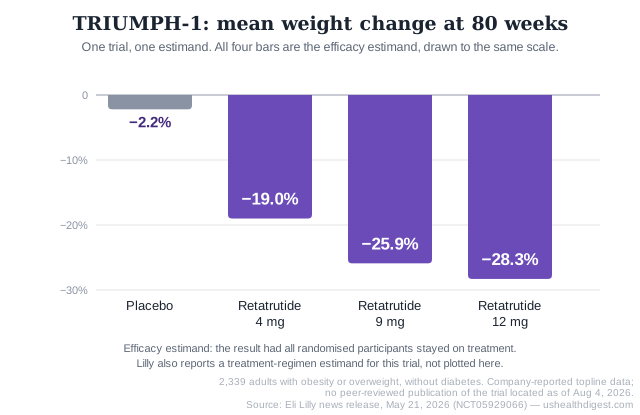
Retatrutide is an investigational once-weekly injectable from Eli Lilly that activates three receptors — GIP, GLP-1 and glucagon. In the Phase 3 TRIUMPH-1 trial of 2,339 adults with obesity or overweight and without diabetes, Lilly reported average weight reductions at 80 weeks of 19.0% on 4 mg, 25.9% on 9 mg and 28.3% on 12 mg, against 2.2% on placebo — under the trial's efficacy estimand, which describes what would have happened had participants stayed on treatment. Under the treatment-regimen estimand, which counts everyone randomised regardless of adherence, the same trial reported 17.6%, 23.7% and 25.0%, against 3.9%. All of it is company-reported topline data: as of August 4, 2026 we could locate no peer-reviewed primary publication of TRIUMPH-1, -2 or -3. No regulator has approved retatrutide, it is available in the US only inside clinical trials, and Lilly says it plans to file with the FDA in the first quarter of 2027.
What a triple agonist is
Semaglutide (Wegovy, Ozempic) acts at one receptor: GLP-1. Tirzepatide (Zepbound, Mounjaro) acts at two, GIP and GLP-1. Retatrutide — molecule code LY3437943 — adds a third: the TRIUMPH programme design paper in Diabetes, Obesity and Metabolism describes it as a triple agonist at the GIP, GLP-1 and glucagon receptors.
Adding glucagon is counter-intuitive, because glucagon raises blood sugar; the rationale is that glucagon-receptor activity increases energy expenditure while the incretin arms suppress appetite and blunt the glucose effect. That was tested in the Phase 2 obesity trial published in the New England Journal of Medicine in 2023, which enrolled 338 adults and reported a least-squares mean weight change at 48 weeks of −24.2% on the highest dose (12 mg) against −2.1% on placebo — a secondary endpoint; the primary endpoint was the change at 24 weeks. All three drugs are peptides — see why GLP-1 drugs are peptides and what peptides actually are.
TRIUMPH-1, and the estimand each number belongs to
Lilly reported TRIUMPH-1 in a press release dated May 21, 2026, headlined "Lilly's triple agonist, retatrutide, delivered powerful weight loss in pivotal Phase 3 obesity trial" — the company's characterisation of its own result. The trial (NCT05929066) randomised 2,339 adults with obesity, or overweight with at least one weight-related comorbidity, and without diabetes, 1:1:1:1 to three doses or placebo for 80 weeks.
The weight results were reported twice, under two estimands. An estimand is the precise question a number answers — not a footnote but the definition of the result. Lilly's definitions:
- Efficacy estimand: "efficacy had all randomized participants remained on study intervention (with possible dose interruptions and modifications) without initiating prohibited weight management treatments."
- Treatment-regimen estimand: "the average treatment effect regardless of adherence to study intervention or initiation of prohibited weight management treatments."
Both are legitimate; they are not interchangeable.
| Arm | Efficacy estimand | Treatment-regimen estimand | ||
|---|---|---|---|---|
| % change | lbs | % change | lbs | |
| Retatrutide 4 mg | −19.0% | −47.2 | −17.6% | −43.7 |
| Retatrutide 9 mg | −25.9% | −64.4 | −23.7% | −58.9 |
| Retatrutide 12 mg | −28.3% | −70.3 | −25.0% | −62.1 |
| Placebo | −2.2% | −5.5 | −3.9% | −9.7 |
Note that the placebo arm moves the opposite way to the drug arms between the two estimands — 2.2% against 3.9% — so the gap between drug and placebo narrows by more than the drug column alone shows. The release does not explain why.
Responders and BMI
At 80 weeks, Lilly reported that 27.8%, 52.9% and 62.5% on 4, 9 and 12 mg reached at least 25% weight loss, against 2.2% on placebo; at 30%, 15.3%, 37.9% and 45.3% against 0.5%; at 35%, 5.9%, 20.8% and 27.2% against 0.3%. It also states 65.3% on 12 mg reached a BMI below 30, including 37.5% of those who began with class 3 obesity (BMI ≥40). The release does not label these rates by estimand, and neither do we.
The week-104 figures are a subgroup — and the placebo arm was on the drug
A 24-week extension to week 104 enrolled 532 participants: those with baseline BMI 35 or above who completed the 80 weeks and tolerated their assigned dose. Per the release, they "received retatrutide once weekly for an additional 24 weeks, including a blinded escalation to maximum tolerated dose (9 mg or 12 mg)." Under the efficacy estimand, measured from that subgroup's heavier baseline of 121.7 kg (268.3 lbs), week-104 reductions were 27.9% (4 mg group), 29.5% (9 mg), 30.3% (12 mg) and 19.2% (original placebo group). Two things make these a different object from the week-80 figures: the denominator is that subgroup — more severe obesity, already 80 weeks tolerant — not the trial, and the original placebo group was on retatrutide throughout the extension, so its 19.2% reflects about 24 weeks of active drug. The 30.3% is not a bigger version of the 28.3%.
What July 23 added: TRIUMPH-2 and TRIUMPH-3
Lilly reported two more Phase 3 trials in a press release dated July 23, 2026. Both report weight under the efficacy estimand only, defined as in TRIUMPH-1 with one addition — the release's wording ends "without initiating prohibited weight management treatments (and glycemic rescue therapy for glycemic endpoints only)."
TRIUMPH-2 (NCT05929079) randomised 1,152 adults with type 2 diabetes and obesity or overweight for 80 weeks. Efficacy estimand: 12.7% on 4 mg, 19.1% on 9 mg, 20.8% on 12 mg, 4.0% on placebo. A1C fell 1.4, 1.6 and 1.5 percentage points against 0.2, from a baseline of 7.7%.
TRIUMPH-3 (NCT05882045) randomised 1,949 adults with severe obesity (BMI ≥35) and established cardiovascular disease, with or without diabetes, for 80 weeks. Efficacy estimand: 21.6% on 9 mg and 22.6% on 12 mg, against 3.2% on placebo. For 12 mg it also reports reductions of 37.0% in triglycerides, 16.5% in non-HDL cholesterol, 9.3 mmHg in systolic blood pressure, 19.0 cm (7.5 in) in waist circumference and 51.2% in hs-CRP — risk-factor and measurement endpoints, which are not the same thing as cardiovascular events.
The release does report events. In pre-specified analyses of time to first occurrence, pooling the 9 mg and 12 mg arms against placebo, there were 44 MACE-5 events (all-cause death, heart attack, stroke, heart failure event or coronary revascularisation) on retatrutide against 52 on placebo — hazard ratio 0.82, 95% CI 0.55 to 1.22; and 27 MACE-3 events (cardiovascular death, heart attack or stroke) against 23 — hazard ratio 1.12, 95% CI 0.64 to 1.96. Both intervals cross 1, on event counts in the tens. TRIUMPH-3 is a weight-management trial in people who already have cardiovascular disease, not a cardiovascular outcomes trial: quoting the 0.82 as a heart benefit, or the 1.12 as a heart risk, goes past what the release supports.
Three trials, three populations. A number from one cannot be set against a number from another: each describes a different group of people, and no such pairing is a head-to-head.
Why the diabetes figure is lower — and what it does not mean
The established reading is not that the drug worked less well in TRIUMPH-2. People with type 2 diabetes lose less weight on incretin drugs than people without it, wherever both have been studied. In STEP 1, in adults without diabetes, mean weight change at week 68 on semaglutide 2.4 mg was −14.9% against −2.4% on placebo; in STEP 2, in adults with type 2 diabetes at the same dose over the same 68 weeks, it was −9.6% against −3.4%. STEP 1's primary estimand assessed effects regardless of treatment discontinuation or rescue intervention; STEP 2's abstract reports its coprimary endpoints as assessed by intention to treat. They are still separate trials: read the pair as a direction, not a measurement, and no STEP figure can be compared with a TRIUMPH figure. See semaglutide results for women and Wegovy versus Zepbound.
Tolerability and the dose gradient
Discontinuation due to adverse events in TRIUMPH-1 was 4.1% on 4 mg, 6.9% on 9 mg and 11.3% on 12 mg, against 4.9% on placebo. In TRIUMPH-2: 3.8%, 11.6%, 7.7% against 4.9%. In TRIUMPH-3: 9.8% on 9 mg and 13.5% on 12 mg against 4.8%. Not perfectly monotonic, but the shape is familiar — the doses producing the largest average weight change are the doses more people stop.
Common adverse events in TRIUMPH-1, 4 / 9 / 12 mg (placebo in brackets): nausea 28.6 / 38.4 / 42.4% (14.8%); diarrhoea 25.2 / 34.1 / 32.0% (13.5%); constipation 23.8 / 25.9 / 26.1% (10.9%); vomiting 10.6 / 22.8 / 25.3% (4.8%). Our guide to GLP-1 side effects in women covers these, for the approved drugs.
Two signals women should know are being discussed
Two entries in the TRIUMPH-1 list are not part of the familiar GLP-1 picture. Dysesthesia — abnormal skin sensation — was reported in 5.1 / 12.3 / 12.5% of the retatrutide groups against 0.9% on placebo; urinary tract infection in 7.5 / 8.8 / 8.4% against 5.3%. Lilly adds that these events were "generally mild to moderate, the majority resolved during treatment, and most participants continued taking retatrutide" — the sponsor's characterisation of unpublished data.
We name the UTI figure rather than bury it because urinary tract infections are markedly more common in women than in men, and a rate from a mixed-sex trial averages over that difference. The release gives pooled rates with no breakdown by sex, so nothing above is a finding about women — it is a reason to watch, not a result. The signal is not inert in the field: a July 23, 2026 letter in the European Journal of Internal Medicine is titled "Retatrutide and the urinary tract infection signal: Is the answer hidden in timing?" We cite it only as evidence the signal is under discussion; we have not read its full text.
The part that is missing: no peer-reviewed primary publication
We searched PubMed on August 4, 2026 and could locate no peer-reviewed primary report of TRIUMPH-1, -2 or -3; what that record holds is the programme design paper and the 2023 Phase 2 trial. That is our own search on a given date, not proof that no such publication exists.
This is not an accusation — reporting topline results ahead of publication is ordinary practice, and Lilly's releases are more explicit about estimands than much of the coverage repeating them. But a press release is written by a sponsor, at a level of detail it chooses. A published paper carries the full safety table, participant disposition, confidence intervals, the prespecified analysis plan, and reviewers who do not work for the sponsor. Until the TRIUMPH papers appear, no independent reader can check the arithmetic.
What is not known
- No head-to-head. Retatrutide has not been compared directly with tirzepatide or semaglutide in any trial we could identify.
- No maintenance or withdrawal data. The releases do not address weight after stopping; for the approved drugs, see stopping a GLP-1 and what happens next.
- No price, no coverage, no launch. Lilly's stated plan to "submit a Biologics License Application (BLA) for retatrutide to FDA in Q1 2027" is not an approval, and no approval date can be stated.
- No sex-stratified safety data in the material released so far.
The gray market: retatrutide is already being sold
A drug no regulator has approved is advertised online as a "research peptide." FDA's page on unapproved GLP-1 drugs used for weight loss, last updated June 15, 2026, describes companies that illegally sold unapproved drugs containing semaglutide, tirzepatide or retatrutide "falsely labeled 'for research purposes' or 'not for human consumption'" while giving consumers dosing instructions. The page also reports that, as of May 31, 2026, FDA had received 990 adverse event reports involving compounded semaglutide and more than 730 involving compounded tirzepatide.
The enforcement record names retatrutide specifically. In a warning letter dated March 31, 2026 to Bernard Gramlich of Gram Peptides, Rancho Santa Fe, California, the FDA said the company's website offered retatrutide — labelled a "GLP-1-R peptide" — alongside tirzepatide labelled a "GLP-2 peptide" and bacteriostatic water. Citing sections 301(d) and 505(a) of the Federal Food, Drug, and Cosmetic Act, it stated the products "are unapproved new drugs," and on the delivery route was blunt: injectables "bypass some of the body's key defenses against toxins and microorganisms." A warning letter is an allegation requiring a written response, not a court judgment or a product test — the same track as FDA's 2026 telehealth warning letters, and the same "research peptide" framing we examined in BPC-157's evidence and legal status.
It cannot lawfully be compounded either
The pathway that keeps semaglutide and tirzepatide flowing through telehealth does not extend to retatrutide. Per FDA's page on bulk drug substances, a substance may be used under section 503A only if it complies with an applicable USP or NF monograph, is a component of an FDA-approved drug product, or appears on FDA's 503A bulks list. Retatrutide is the active ingredient of no FDA-approved drug and appears in no category of that list. FDA states the bottom line outright on the GLP-1 page cited above: "Retatrutide and cagrilintide cannot be used in compounding under federal law." See compounded versus branded GLP-1s and peptide therapy costs.
On the reported death
On July 9, 2026 the BMJ published a news fact check by Elisabeth Mahase, "Retatrutide fact check: Has a man died after taking the unapproved weight loss jab?" (BMJ 2026;394:e100245). We could not access its full text, so we report only that the BMJ examined reports that a man died after taking an unapproved retatrutide product. We are not characterising its conclusion, and readers should treat any secondhand account of that case as unverified.
Questions worth asking if you see retatrutide advertised
- Is this FDA-approved? For retatrutide, in August 2026, the only correct answer is no.
- Which trial result is being quoted, and under which estimand? A seller quoting "28.3%" is quoting TRIUMPH-1's efficacy estimand for 12 mg — a trial-supplied product given under clinical supervision, not the vial in the advertisement.
- Who made this, and what is in it? An unapproved injectable bought online has no verified identity, purity, sterility or concentration.
- Is it called "compounded"? The label does not make it lawful.
- Is there an approved option I have not tried? Three triple-agonist trials do not change what is prescribable today; see our GLP-1 FAQ for women and oral GLP-1 pills in 2026.
Retatrutide will matter if the papers, the regulatory review and the long-term safety record hold up. None of the three has happened — and the gap between a 2026 press release and a prescription pad is being filled by people selling something else under the same name.
Sources
- Eli Lilly and Company. "Lilly's triple agonist, retatrutide, delivered powerful weight loss in pivotal Phase 3 obesity trial." Company press release, May 21, 2026 — TRIUMPH-1 design, NCT05929066, both estimand definitions, all week-80 and week-104 figures, responder rates, BMI outcomes, discontinuation and adverse event rates. investor.lilly.com/news-releases/news-release-details/lillys-triple-agonist-retatrutide-delivered-powerful-weight-loss
- Eli Lilly and Company. "Lilly's triple agonist, retatrutide, successful in two additional Phase 3 obesity trials, delivering significant improvements in weight and A1C." Company press release, July 23, 2026 — TRIUMPH-2 and TRIUMPH-3 populations, efficacy-estimand weight and A1C results, cardiometabolic risk-factor endpoints, the pre-specified MACE-5 and MACE-3 event counts and hazard ratios, discontinuation rates, and the Q1 2027 BLA statement. prnewswire.com/news-releases/…-302832674.html
- Giblin K, Kaplan LM, Somers VK, et al. "Retatrutide for the treatment of obesity, obstructive sleep apnea and knee osteoarthritis: Rationale and design of the TRIUMPH registrational clinical trials." Diabetes Obes Metab 2026;28(1):83–93, published online October 15, 2025 — programme design and the description of retatrutide as a GIP/GLP-1/glucagon triple agonist. pubmed.ncbi.nlm.nih.gov/41090431
- Jastreboff AM, et al. "Triple-Hormone-Receptor Agonist Retatrutide for Obesity — A Phase 2 Trial." N Engl J Med 2023 — the 338-participant Phase 2 trial and its 48-week results. pubmed.ncbi.nlm.nih.gov/37366315
- Koufakis T, Argyrakopoulou G, Kokkinos A, le Roux CW. "Retatrutide and the urinary tract infection signal: Is the answer hidden in timing?" Eur J Intern Med, published online July 23, 2026 — cited solely as evidence that the UTI signal is being discussed in the clinical literature; we have not read the full text. pubmed.ncbi.nlm.nih.gov/42493254
- Mahase E. "Retatrutide fact check: Has a man died after taking the unapproved weight loss jab?" BMJ 2026;394:e100245, July 9, 2026 — cited only for the fact that the BMJ examined such reports; full text not accessible to us, and its conclusion is not characterised here. pubmed.ncbi.nlm.nih.gov/42425580
- US Food and Drug Administration. "FDA's Concerns with Unapproved GLP-1 Drugs Used for Weight Loss." Last updated June 15, 2026 — the "for research purposes" labelling language naming retatrutide, and the adverse event counts as of May 31, 2026 (990 for compounded semaglutide; more than 730 for compounded tirzepatide). fda.gov/drugs/drug-alerts-and-statements/fdas-concerns-unapproved-glp-1-drugs-used-weight-loss
- US Food and Drug Administration. Warning letter to Gram Peptides / Bernard Gramlich, MARCS-CMS 721806, dated March 31, 2026 — the products observed on the website, the FD&C Act sections cited, and the quoted language on unapproved new drugs and injectable risk. fda.gov/…/warning-letters/gram-peptides-721806-03312026
- US Food and Drug Administration. "Bulk Drug Substances Used in Compounding Under Section 503A of the FD&C Act" — the three conditions under which a bulk substance may be used in 503A compounding. fda.gov/drugs/human-drug-compounding/bulk-drug-substances-used-compounding-under-section-503a-fdc-act
- Wilding JPH, et al. "Once-Weekly Semaglutide in Adults with Overweight or Obesity" (STEP 1). N Engl J Med 2021 — the −14.9% versus −2.4% week-68 result in adults without diabetes. pubmed.ncbi.nlm.nih.gov/33567185
- Davies M, et al. "Semaglutide 2·4 mg once a week in adults with overweight or obesity, and type 2 diabetes (STEP 2)." Lancet 2021 — the −9.6% versus −3.4% week-68 result in adults with type 2 diabetes. pubmed.ncbi.nlm.nih.gov/33667417
This article is general information, not medical or legal advice. Retatrutide is investigational, is not approved by any regulator, and is not available by prescription in the United States. Discuss any weight-loss medication decision with a licensed clinician who knows your health history.