
News & Trends
Wegovy HD: what semaglutide 7.2 mg actually buys over 2.4 mg
On March 19, 2026 the FDA approved a higher maintenance dose of injectable semaglutide — Wegovy HD, 7.2 mg once weekly, logged in the agency's database as an "Efficacy-New Dosing Regimen" supplement. In the phase 3b STEP UP trial, mean bodyweight change at 72 weeks was −18.7% on 7.2 mg, −15.6% on 2.4 mg and −3.9% on placebo, under the treatment policy estimand — the co-primary analysis, counting everyone as randomised whether or not they stayed on the drug. The gain over the dose most people already take is an estimated treatment difference of −3.1 percentage points (95% CI −4.7 to −1.6), and it is not free: gastrointestinal events were reported by 70.8% on 7.2 mg versus 61.2% on 2.4 mg, and dysaesthesia — altered skin sensation — by 22.9% versus 6.0%, at $399 a month self-pay against $349.
What was approved, and what the label permits
Drugs@FDA lists the action under NDA 215256 as SUPPL-29, approved March 19, 2026, classification "Efficacy-New Dosing Regimen". It was reviewed under the FDA's Commissioner's National Priority Voucher pilot: the agency's own program page logs "March 19, 2026: FDA Approves Fourth Product Under National Priority Voucher Program, Higher Dose Semaglutide", and Novo Nordisk's global release says the FDA "awarded a Commissioner's National Priority Voucher for Wegovy® HD, accelerating its review".
That voucher buys review speed, not an easier evidence bar. The FDA describes a target of "1-2 months" against "6+ months", and states that applications selected for the program "will be subject to the same statutory and regulatory requirements for approval" as anything outside it. That is a different thing from Accelerated Approval, the named pathway under which a drug is cleared on a surrogate endpoint with confirmatory trials required afterwards. Novo's global release and its chief executive use "accelerated approval" in what reads as the ordinary-language sense; some trade coverage has repeated it as though it named that pathway. The Drugs@FDA entry for SUPPL-29 carries no accelerated-approval designation, but it does not state a pathway either way, so we cannot fully confirm that question from the FDA record. One trap for anyone checking this: Novo issued two releases that day, and the US one on PR Newswire names neither the voucher nor "accelerated approval". Read only that one and you would conclude the designation did not exist.
What the label permits is narrower than the headlines suggest. The current Wegovy prescribing information (revised 6/2026) reaches 7.2 mg in one place only — the maintenance paragraph for weight reduction in adults: "For patients who tolerate the 2.4 mg dosage for at least 4 weeks and additional weight reduction is clinically indicated, the dosage may be increased to a maximum dosage of 7.2 mg subcutaneously once weekly."
Every other maintenance paragraph stops lower: 2.4 mg (recommended) or 1.7 mg weekly for cardiovascular risk reduction and for patients aged 12 and older, 2.4 mg weekly for noncirrhotic MASH. Nothing extends 7.2 mg to the cardiovascular indication, to adolescents, or to MASH. It exists only as a single-dose pen, not in the syringes or the multi-dose FlexTouch, and the escalation ladder to it is unchanged: 0.25 mg weeks 1–4 through 1.7 mg weeks 13–16, maintenance from week 17.
What STEP UP found
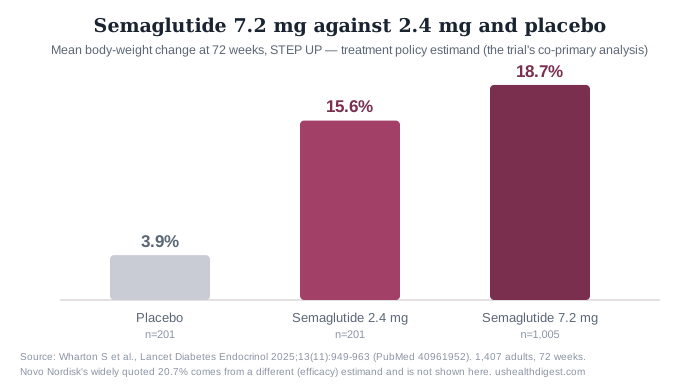
STEP UP was a phase 3b, randomised, double-blind trial with placebo and active-comparator arms across 95 sites in 11 countries, enrolling January 2023 to November 2024. Adults with a BMI of 30 kg/m² or greater and without diabetes were randomised 5:1:1 to semaglutide 7.2 mg (n=1005), 2.4 mg (n=201) or placebo (n=201), all with lifestyle intervention, for 72 weeks. 1,037 of 1,407 participants (73.7%) were female, mean age 47, mean bodyweight 113.0 kg, mean BMI 39.9 — so nearly three in four enrollees were women, and at that BMI the average one started heavier than the typical reader. The co-primary endpoints were percentage change in bodyweight and the proportion reaching a reduction of 5% or greater, 7.2 mg versus placebo, under the treatment policy estimand.
| Outcome at week 72 (treatment policy estimand) | Semaglutide 7.2 mg (n=1005) | Semaglutide 2.4 mg (n=201) | Placebo (n=201) |
|---|---|---|---|
| Mean change in bodyweight | −18.7% (SE 0.4) | −15.6% (SE 0.7) | −3.9% (SE 0.6) |
| Treatment difference vs placebo | −14.8% (95% CI −16.2 to −13.4) | — | reference |
| Treatment difference vs 2.4 mg | −3.1% (95% CI −4.7 to −1.6) | reference | — |
| Waist circumference vs placebo | −11.7 cm (95% CI −13.0 to −10.4) | — | reference |
All cells: Wharton and colleagues, STEP UP; all differences p<0.0001.
The threshold comparisons are odds ratios, not headcounts
The threshold endpoints are proportions, but the published comparisons on them are odds ratios — a distinction most coverage flattens. Against placebo, 7.2 mg participants were more likely to reach reductions of 5% or greater (odds ratio 12.1, 95% CI 8.3–17.6), 10% or greater (14.5), 15% or greater (20.3), 20% or greater (27.3) and 25% or greater (127.4, 36.8–441.4). An odds ratio of 127 does not mean 127 times as many people; it reflects how vanishingly few people on placebo reached a 25% reduction. The informative comparison is the active arm: versus 2.4 mg, the odds of reaching 20% or greater were 1.8 (1.3–2.4) and 25% or greater 2.4 (1.6–3.5) — roughly double, and far less than "127" implies. The plain proportions sit in the label rather than the abstract: for STEP UP it records 45.5% on 7.2 mg, 32.3% on 2.4 mg and 2.8% on placebo losing 20% or more of bodyweight, intention-to-treat.
The 20.7% everyone quotes answers a different question
Novo Nordisk's US release presents two average-weight-loss rows. Under its efficacy estimand — defined in its own footnote as "estimated efficacy in an idealized scenario in which all patients stayed on treatment and took no other weight loss therapies" — it gives "~21% (20.7%)" for 7.2 mg and "~18% (17.5%)" for 2.4 mg. Under what it calls the treatment regimen estimand — "treatment effect regardless of whether patients stayed on treatment" — it gives "~19% (18.8%)" and "~16% (15.5%)".
That second row asks what the paper's treatment policy estimand asks, under another name; the published figures are −18.7% and −15.6% against the US release's 18.8% and 15.5%, a tenth of a point apart — and Novo's own two releases do not agree with each other, since the global one puts the treatment-regimen figure at 18.7%, matching the paper. An idealised "if everyone stayed on treatment" estimate is legitimate, but it is not what happens to real patients, some of whom stop. Setting 20.7% beside a treatment-policy number from another trial compares two different questions — the commonest error in coverage of this class. The release's threshold claim needs the same care: "about one in three trial participants taking Wegovy® HD achieved 25% weight loss or higher" maps to a row reading 31.2%, 15.3% and 0%, marked with the treatment regimen estimand footnote.
Dysaesthesia: the least-covered fact about this dose
Dysaesthesia is an altered and usually unpleasant skin sensation — tingling, burning, prickling, or skin oddly sensitive to touch or clothing. Roughly one in five on 7.2 mg reported something in that family: 230 of 1,004 participants (22.9%) on 7.2 mg in STEP UP, 12 of 201 (6.0%) on 2.4 mg and one (0.5%) on placebo. The label's 22% versus 6% versus 0.3% is a near neighbour, not the same count: it pools STEP UP with STEP UP T2D — 288 affected patients across both trials, out of 1,311 given 7.2 mg — and covers a wider list of altered-sensation terms. Novo Nordisk's release calls that cluster "sensitive skin, hyperesthesia, dysesthesia and paresthesia."
The label reports that "among 288 patients who experienced dysesthesia with WEGOVY 7.2 mg injection, 2% permanently discontinued treatment, 8% had temporary interruption, and 23% had dose reduction; most subjects with these actions taken to WEGOVY 7.2 mg injection … recovered from the event." So for about a quarter of those affected it meant coming back down a dose. Two figures from the same section keep "reversible" from being the whole story: 18% "did not report recovering during the trial duration", and of 38 patients re-escalated to 7.2 mg after recovering, 17 (45%) had it come back. The STEP UP T2D authors named it in their conclusion — "safety and tolerability were comparable between semaglutide 7·2 mg and 2·4 mg, except for the imbalance in dysaesthesia."
Stomach side effects, and one number that cuts the other way
Gastrointestinal events were reported by 711 of 1,004 (70.8%) on 7.2 mg, 123 of 201 (61.2%) on 2.4 mg and 86 of 201 (42.8%) on placebo — a ten-point rise in the share reporting nausea, vomiting or constipation. Our guide to GLP-1 side effects in women covers what those look like week to week.
Serious adverse events did not follow the same direction: 68 of 1,004 (6.8%) on 7.2 mg, 22 of 201 (10.9%) on 2.4 mg and 11 of 201 (5.5%) on placebo — numerically higher in the 2.4 mg arm. With 201 people in that group a handful of events moves the percentage several points, and this was not an endpoint the trial was powered to test. It is not evidence the higher dose is safer; nor should it be dropped.
With type 2 diabetes, the numbers are smaller
A companion trial, STEP UP T2D, tested the same dose in adults with obesity and type 2 diabetes: 512 participants at 68 sites, randomised 3:1:1 for 72 weeks; 265 (51.8%) female, mean age 56, mean BMI 38.6, HbA1c 8.1%. Against placebo, 7.2 mg produced a mean bodyweight change of −13.2% versus −3.9%, an estimated treatment difference of −9.3% (95% CI −11.0 to −7.7) — figures the paper's abstract does not tag with an estimand, though Novo's global release reports the same −13.2% as its treatment-regimen number, against 14.1% under its efficacy estimand — and HbA1c −1.5% (−1.8 to −1.2), with dysaesthesia in 58 of 307 (18.9%) versus five of 103 (4.9%) and none on placebo.
The gap between −18.7% without diabetes and −13.2% with it is no quirk of these two trials: 2.4 mg produced −14.9% in STEP 1, without diabetes, and −9.6% in STEP 2, with type 2 diabetes. If you have type 2 diabetes, calibrate to the diabetes trials.
What it costs
On Novo Nordisk's own patient-facing pages, read August 6, 2026, the self-pay price is $399 per month for the Wegovy HD 7.2 mg pen (footer code US26SEMO00905, June 2026), against $349 for the standard pen doses, after a limited-time introductory $199 a month for the first two months at 0.25 mg or 0.5 mg. NovoCare's pharmacy page shows the same $399 and $349 self-pay figures. The step up therefore costs roughly $50 a month, about $600 a year — and coverage of a maximum dosage is not automatically coverage of the recommended one. See our guides to cost without insurance, 2026 coverage and appealing a denial. Manufacturer pricing pages change without notice; check the date stamp on any you read.
Does 7.2 mg change the tirzepatide comparison?
Not on evidence that exists today. The only randomised head-to-head of the two drugs is SURMOUNT-5, an open-label trial in which 751 adults with obesity and without type 2 diabetes took the maximum tolerated dose of tirzepatide (10 mg or 15 mg) or of semaglutide (1.7 mg or 2.4 mg) for 72 weeks, for a least-squares mean weight change of −20.2% versus −13.7%. It did not test 7.2 mg, and we could not locate any completed randomised head-to-head of 7.2 mg against tirzepatide.
So the tempting arithmetic — STEP UP's −18.7% beside SURMOUNT-5's −20.2% or SURMOUNT-1's up to −20.9% — is exactly what the evidence does not support: different trials, populations, comparators, and analyses that do not always name the same estimand (SURMOUNT-5's abstract reports a least-squares mean change without naming one). Novo's release is carefully worded here: "no other weight loss medicine has been studied to show superiority to Wegovy® HD" says none has been shown superior, not that this one beat tirzepatide. Our Wegovy versus Zepbound comparison covers the direct evidence.
Questions worth asking a prescriber
- Have I tolerated 2.4 mg for at least four weeks? The label's precondition, alongside further weight reduction being "clinically indicated".
- What am I buying, in this trial's terms? −3.1 percentage points over 2.4 mg (95% CI −4.7 to −1.6), treatment policy estimand — an average, with wide individual variation. If I have type 2 diabetes, STEP UP T2D's −13.2% is the benchmark instead.
- What is the plan if I get altered skin sensation? Among affected patients the label records 23% having a dose reduction, 8% an interruption and 2% stopping permanently.
- Does my plan cover 7.2 mg specifically? The self-pay difference is $399 versus $349 a month.
- What happens if I come off it? Dose is separate from durability — see what happens when you stop a GLP-1.
Where this leaves the picture
A higher dose is now approved and does more on average than the old one — "semaglutide 7·2 mg was superior to placebo and 2·4 mg for bodyweight reduction in adults with obesity, while retaining a favourable risk-benefit profile," the STEP UP authors wrote. Both trials were funded by Novo Nordisk, and three of STEP UP's nine named authors are listed with affiliations at the sponsor — ordinary for phase 3 work, and worth knowing.
But the size of the gain sets the terms: about three percentage points of bodyweight on average over 72 weeks — roughly three and a half kilograms at the trial's mean 113 kg — against a ten-point rise in gastrointestinal events, an almost fourfold rise in altered skin sensation, and around $600 more a year. For a woman who has plateaued on 2.4 mg and tolerates it well, that may be a reasonable trade; for one already finding 2.4 mg difficult, the label's own escalation logic argues against it. Our semaglutide results guide and GLP-1 FAQ cover what comes before dose. This is a meaningful increment, not a different category of drug.
Sources
- Wharton S, Freitas P, Hjelmesæth J, Kabisch M, Kandler K, Lingvay I, Quiroga M, Rosenstock J, Garvey WT, STEP UP trial group. Once-weekly semaglutide 7·2 mg in adults with obesity (STEP UP): a randomised, controlled, phase 3b trial. The Lancet Diabetes & Endocrinology 2025 Nov;13(11):949–963 (published online September 14, 2025). doi:10.1016/S2213-8587(25)00226-8. ClinicalTrials.gov NCT05646706. pubmed.ncbi.nlm.nih.gov/40961952
- Lingvay I, Bergenheim SJ, Buse JB, Freitas P, Garvey WT, Harder-Lauridsen NM, Rosenstock J, Sahu K, Wharton S, STEP UP T2D trial group. Once-weekly semaglutide 7·2 mg in adults with obesity and type 2 diabetes (STEP UP T2D): a randomised, controlled, phase 3b trial. The Lancet Diabetes & Endocrinology 2025 Nov;13(11):935–948 (published online September 14, 2025). doi:10.1016/S2213-8587(25)00225-6. ClinicalTrials.gov NCT05649137. Correction published as Lancet Diabetes Endocrinol 2026 Jun;14(6):e9; we could not retrieve the correction text and did not rely on it. pubmed.ncbi.nlm.nih.gov/40961953
- WEGOVY (semaglutide) injection, for subcutaneous use — full prescribing information. Novo Nordisk, revised 6/2026; DailyMed record updated June 18, 2026. Read August 6, 2026. dailymed.nlm.nih.gov/dailymed/drugInfo.cfm?setid=ee06186f-2aa3-4990-a760-757579d8f77b
- US Food and Drug Administration. Drugs@FDA approval history for Wegovy, NDA 215256 — supplement SUPPL-29 approved March 19, 2026, submission classification "Efficacy-New Dosing Regimen". Read August 6, 2026. accessdata.fda.gov/scripts/cder/daf/index.cfm?ApplNo=215256
- Novo Nordisk Inc. (company press release). FDA approves Novo Nordisk's new Wegovy® HD injection, delivering the highest weight loss to date for a Wegovy® injection, adding to its already expansive clinical profile. PR Newswire, March 19, 2026. prnewswire.com/news-releases/…-302718982.html
- Novo Nordisk A/S (company announcement No 19/2026). Wegovy® HD (semaglutide 7.2 mg) approved in the US, providing 20.7% mean weight loss. GlobeNewswire, March 19, 2026. This global release, unlike the US one above, names the Commissioner's National Priority Voucher. Read August 6, 2026. globenewswire.com/news-release/2026/03/19/3259259
- US Food and Drug Administration. Commissioner's National Priority Voucher (CNPV) Pilot Program. Read August 6, 2026. fda.gov/industry/commissioners-national-priority-voucher-cnpv-pilot-program
- Novo Nordisk. Wegovy® Cost & Coverage Information (self-pay prices; footer code US26SEMO00905, June 2026). Read August 6, 2026. wegovy.com/obesity/what-to-pay-for-wegovy.html
- NovoCare®. Wegovy® (semaglutide) Savings, Self Pay, & Home Delivery. Novo Nordisk. Read August 6, 2026. novocare.com/pharmacy/wegovy/offer.html
- Wilding JPH, Batterham RL, Calanna S, et al., STEP 1 Study Group. Once-Weekly Semaglutide in Adults with Overweight or Obesity. New England Journal of Medicine 2021 Mar 18;384(11):989–1002 (published online February 10, 2021). pubmed.ncbi.nlm.nih.gov/33567185
- Davies M, Færch L, Jeppesen OK, et al., STEP 2 Study Group. Semaglutide 2·4 mg once a week in adults with overweight or obesity, and type 2 diabetes (STEP 2): a randomised, double-blind, double-dummy, placebo-controlled, phase 3 trial. The Lancet 2021 Mar 13;397(10278):971–984. pubmed.ncbi.nlm.nih.gov/33667417
- Jastreboff AM, Aronne LJ, Ahmad NN, et al., SURMOUNT-1 Investigators. Tirzepatide Once Weekly for the Treatment of Obesity. New England Journal of Medicine 2022 Jul 21;387(3):205–216 (published online June 4, 2022). pubmed.ncbi.nlm.nih.gov/35658024
- Aronne LJ, Horn DB, le Roux CW, et al., SURMOUNT-5 Trial Investigators. Tirzepatide as Compared with Semaglutide for the Treatment of Obesity. New England Journal of Medicine 2025 Jul 3;393(1):26–36 (published online May 11, 2025). ClinicalTrials.gov NCT05822830. pubmed.ncbi.nlm.nih.gov/40353578