
Weight & Metabolic Health
Do GLP-1 drugs make you lose muscle? What the trials measured — and what they never measured at all
Lean body mass does fall on GLP-1 medication — but "lean mass" is not "muscle," and the fall is roughly proportional to the weight lost. In a 2026 meta-analysis of randomized trials, GLP-1 receptor agonists reduced lean body mass by a mean difference of −1.51 kg versus placebo or active comparator (95% CI −2.00 to −1.01), and lean tissue accounted for 28% of total weight lost (95% CI 22%–34%) — that second figure pooled across the GLP-1 and SGLT2-inhibitor trials together, not GLP-1 drugs alone. It is a proportion the authors call "congruent with overall weight loss," and one not modified by sex. In the semaglutide 2.4 mg body-composition substudy, fat fell faster than lean tissue: −9.3 kg fat against −5.8 kg lean, so lean mass rose 3.4 percentage points as a share of the body. The real gap is not kilograms. It is that almost no trial has measured whether strength and physical function hold up.
First, a definition problem that changes the argument
Nearly every page on this subject treats "lean body mass" and "muscle" as the same thing. They are not, and composition is measured two ways: DXA (dual-energy X-ray absorptiometry), a low-dose X-ray scan sorting the body into fat, bone mineral and lean soft tissue, and bioimpedance, which estimates the same split from how readily a small electrical current passes through the body. Both report a lean compartment defined by subtraction — everything that is not fat and not bone. Skeletal muscle is in there, but so is the water inside and around your cells, your organs, connective tissue, and glycogen, the body's carbohydrate reserve, stored together with water.
Rapid weight loss depletes glycogen and shifts body water, so a scan taken then records a drop in "lean mass" that is partly fluid and carbohydrate rather than lost muscle fiber. Some muscle is lost. But the kilogram figure is an upper bound on muscle loss, not a measurement of it, and neither method can say how the total divides.
The pooled evidence, and what the numbers are numbers of
The fullest synthesis available is a systematic review published in Diabetes/Metabolism Research and Reviews in July 2026, pooling 36 randomized controlled trials — 21 of GLP-1 receptor agonists, 15 of SGLT2 inhibitors as a comparison class. Populations: obesity (8 studies), type 2 diabetes (20), type 1 diabetes (5) and polycystic ovary syndrome (3), a group we cover in our piece on GLP-1 drugs and PCOS.
For GLP-1 receptor agonists, the mean difference in lean body mass was −1.51 kg (95% CI −2.00 to −1.01) — the average change in the drug group minus the average change in the comparison group, so lean mass lost beyond what comparator groups lost, not the total drop on the scan. The confidence interval is the range in which the true value plausibly sits; because this one does not cross zero, the effect is distinguishable from no effect.
More useful is the second figure — with one caveat attached to it, that the authors calculated it across both drug classes together rather than for GLP-1 agonists alone: lean tissue accounted for 28% of overall weight lost (95% CI 22%–34%). Roughly seven-tenths fat, three-tenths lean is about what weight loss by other means produces. The authors' conclusion is deliberately unexciting: the loss "appears congruent with overall weight loss," and monitoring plus combined therapy to preserve lean mass "should be considered." Results were not modified by sex, and were "largely consistent" across outcome type, measurement technique and disease status.
The caveat that matters most: the search stopped in October 2022
The literature search ran from inception to October 2022 — before most of the drugs readers are actually asking about had reported their obesity programs. The pooled studies skew toward older agents at diabetes-range doses, not semaglutide 2.4 mg weekly and not tirzepatide, which reached up to −20.9% mean body weight at 72 weeks in SURMOUNT-1 and outperformed semaglutide head-to-head. Because the newer drugs remove far more weight, the absolute kilograms of lean mass lost are very likely larger. Whether the 28% proportion holds at that magnitude is the open question, and this meta-analysis cannot answer it. Anyone quoting −1.51 kg as "the number for Wegovy" is misusing it.
The semaglutide-specific picture: STEP 1's DXA substudy
One dataset speaks to semaglutide 2.4 mg directly. STEP 1, the 68-week trial behind the drug's weight-management approval, produced a mean weight change of −14.9% versus −2.4% on placebo in 1,961 adults, 1,453 of them (74.1%) female, mean age 46. Inside it sat a DXA substudy, with body-composition data analysed for 83 participants on semaglutide and 39 on placebo.
In the semaglutide group it recorded −9.3 kg fat mass, −5.8 kg lean mass, and a +3.4 percentage-point rise in lean mass as a share of total body mass. That last figure confuses people. Lean mass in kilograms went down; lean mass as a percentage of the body went up. Both are true because fat came off faster: when the denominator shrinks more than the numerator, the fraction rises.
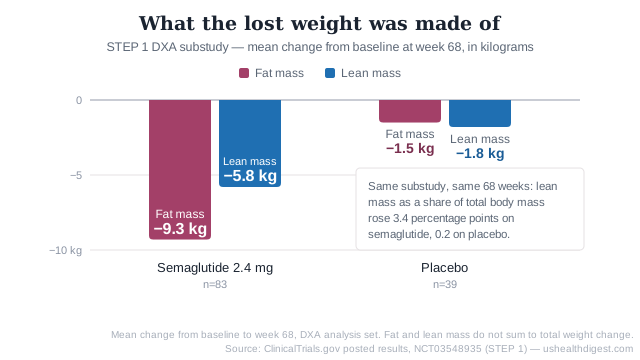
Three limits: 122 people is a small sample, so the estimate is imprecise; these are changes within the treated group, not placebo-subtracted differences; and DXA carries the definitional problem above.
What each study actually measured
| Evidence | Drug and setting | The number | What kind of number it is |
|---|---|---|---|
| 2026 meta-analysis, 21 GLP-1 trials (search to Oct 2022) | Mixed GLP-1 agonists, mostly diabetes-range doses | Lean mass −1.51 kg (95% CI −2.00 to −1.01) | Between-group mean difference vs placebo or active comparator, pooled across trials of differing length |
| Same meta-analysis | Both drug classes pooled | 28% (95% CI 22%–34%) | Proportion of weight lost that was lean tissue — a percentage, not a mass |
| Same meta-analysis, 15 trials | SGLT2 inhibitors (comparison class) | Lean mass −1.04 kg (95% CI −1.45 to −0.64) | Between-group mean difference |
| STEP 1 DXA substudy (83 drug, 39 placebo) | Semaglutide 2.4 mg weekly, 68 weeks, no diabetes | Fat −9.3 kg; lean −5.8 kg; lean share +3.4 points | Changes within the semaglutide group — not placebo-subtracted |
| Lundgren trial, 1 year | Liraglutide 3.0 mg and/or exercise, after an 8-week diet | Body fat −3.9 points (combination), −2.2 (exercise), −2.0 (liraglutide) | Treatment effect on body-fat percentage versus placebo, in percentage points — a different unit from every row above |
The rows are not comparable with one another: kilograms, percentages of weight lost and percentage points of body fat are three distinct units.
The one randomized test of doing something about it
Does adding exercise change the composition of the loss? In a 2021 New England Journal of Medicine trial, adults with obesity (BMI 32–43) and without diabetes completed an 8-week low-calorie diet in which 195 participants lost a mean of 13.1 kg, then were randomized for one year to exercise plus placebo, liraglutide 3.0 mg daily, exercise plus liraglutide, or placebo alone.
Weight change versus placebo at one year: exercise −4.1 kg (95% CI −7.8 to −0.4), liraglutide −6.8 kg (95% CI −10.4 to −3.1), combination −9.5 kg (95% CI −13.1 to −5.9). The combination beat exercise alone by −5.4 kg (95% CI −9.0 to −1.7) — but against liraglutide alone the difference was −2.7 kg, 95% CI −6.3 to 0.8, an interval crossing zero. On weight, the combination was not statistically distinguishable from the drug by itself. This is the finding most often misreported.
Body-fat percentage is where the arms separated — and here the trial's own abstract has misled a great deal of coverage. Measured against placebo, body fat fell 3.9 percentage points on the combination (95% CI −5.4 to −2.5), 2.2 points with exercise alone (95% CI −3.8 to −0.7) and 2.0 points with liraglutide alone (95% CI −3.5 to −0.6). The figures −1.7 and −1.9 points, widely repeated as the single-treatment effects, are nothing of the kind: they are how much further the combination pushed body fat below the exercise group and below the liraglutide group. Read correctly, the combination did roughly double what either component managed alone. Only the combination improved glycated hemoglobin (HbA1c), insulin sensitivity and cardiorespiratory fitness. Adding exercise produced better-composed weight loss, not more of it.
Two limits: the trial used liraglutide 3.0 mg, older and less potent than semaglutide 2.4 mg or tirzepatide, and it studied weight-loss maintenance after a diet, not the initial loss phase most readers are in. On safety, liraglutide alone raised resting heart rate at one year — a finding not seen with the combination — and gallstones as a serious adverse event were reported more often in the liraglutide group than in the combination group.
What this does and does not tell you
Established: lean mass declines measurably, at roughly 28% of weight lost in the pooled analysis above, and the effect is not modified by sex. A second 2026 review — a systematic review in Annals of Internal Medicine, its search running to February 2026 — reports a median of 28.3% (IQR 15.9%–39.9%) across incretin interventions. Resist the tidy match. One figure is a mean pooled across trials with a 95% confidence interval, covering GLP-1 and SGLT2-inhibitor studies together; the other is a median across incretin interventions only, carrying an interquartile range that runs from 16% to 40%, and its authors could not pool at all, because measurement methods varied too much to permit a meta-analysis. Two different kinds of number that happen to land in the same place — which is agreement of a much weaker sort than it looks.
Not established: whether strength, walking speed, grip or the ability to carry groceries are preserved. Composition and function are different endpoints, and the trials overwhelmingly measured the first — that same Annals review, screening the literature through February 2026, found that no included study reported objective physical function outcomes at all. A woman who loses 5 kg of lean mass and gets stronger and one who loses 5 kg and gets weaker look identical on DXA. Also unknown: what happens over five or ten years, what happens at maintenance, and whether the 28% holds for tirzepatide.
What would settle it: trials in current drugs and doses pairing composition scanning with pre-specified strength and function testing, reporting by sex and age, and following participants past active loss into maintenance. Until then, anyone calling GLP-1 muscle loss either a crisis or a non-issue is going beyond the data.
What the trials tested — not a prescription
The one intervention with randomized evidence behind it is supervised exercise alongside the drug, above. On protein, the meta-analysis authors recommend that "combined therapy" to preserve lean mass be considered, without specifying a regimen — and we will not invent one. We publish no gram-per-kilogram target because we have no trial in this population to source it to. What eating adequate protein on a suppressed appetite involves is covered in our guide to protein-first eating on GLP-1 medication, with age-specific context in what the trials do and don't say about women over 40. None of this tests a product, so ignore anyone selling one on the strength of it.
A final point: what you lose is not necessarily what you regain. Weight returns after stopping — substantially, in the SURMOUNT-4 withdrawal trial — and no published trial has adequately characterized the fat-versus-lean makeup of regained weight. See what happens when you stop.
Questions to ask your prescriber
- Will body composition be measured at all, and how? Many arrangements track only scale weight. Ask whether DXA or bioimpedance is available — and if it is a bathroom-scale reading, how much weight to put on it.
- What is my baseline? Composition is interpretable only as change from a starting point, so a single mid-treatment scan tells you little.
- How will strength or function be checked? This is the endpoint the trials skipped. If nothing is monitored, you cannot detect the outcome that matters most.
- What changes when active weight loss stops? Evidence on lean mass in long-term maintenance is thin.
- Does my history change the calculation? Low muscle mass, frailty, older age or a history of falls are reasons to raise this more urgently.
- What happens if I stop or lose coverage? An interruption is foreseeable, not hypothetical.
For the broader efficacy picture, see our review of what semaglutide trials show in women; for questions that arise before starting, our GLP-1 FAQ for women. The muscle question deserves neither dismissal nor panic. It deserves a baseline, a scan, and a prescriber who will answer it.
Sources
- Jobanputra R, Sargeant JA, Plekhanova T, James E, Almaqhawi A, Webb DR, Davies MJ, Yates T. The Effects of Glucagon-Like Peptide-1 Receptor Agonists and Sodium-Glucose Co-Transporter-2 Inhibitors on Lean Body Mass in Humans: A Systematic Review and Meta-Analysis of Randomised Controlled Trials. Diabetes/Metabolism Research and Reviews, 2026 Jul;42(5):e70194 — 36 randomized trials, searched from inception to October 2022; source for the −1.51 kg mean difference, the 28% proportion, the SGLT2 inhibitor comparison, the absence of a sex effect, and the authors' conclusions. pubmed.ncbi.nlm.nih.gov/42319968
- Batsis JA, et al. Effect of Incretin-Based and Nonpharmacologic Weight Loss on Body Composition: A Systematic Review. Annals of Internal Medicine, 2026 — searched January 2003 to February 2026; a narrative synthesis, because heterogeneous body-composition methods and reporting precluded meta-analysis. Source for the median 28.3% (IQR 15.9%–39.9%) of total weight loss attributable to muscle-based indices in incretin groups, and for the finding that no included study reported objective physical function outcomes. pubmed.ncbi.nlm.nih.gov/41996180
- ClinicalTrials.gov. STEP 1 trial registration and results record, NCT03548935 — source for the DXA substudy (83 semaglutide, 39 placebo; −9.3 kg fat mass, −5.8 kg lean mass, +3.4 percentage-point rise in lean share) and for the breakdown of 1,453 of 1,961 (74.1%) participants female, mean age 46. clinicaltrials.gov/study/NCT03548935
- Wilding JPH, et al. Once-Weekly Semaglutide in Adults with Overweight or Obesity (STEP 1). New England Journal of Medicine, 2021 Mar 18;384(11):989–1002 — mean −14.9% body weight at 68 weeks versus −2.4% on placebo, n=1,961. pubmed.ncbi.nlm.nih.gov/33567185
- Lundgren JR, Janus C, Jensen SBK, et al. Healthy Weight Loss Maintenance with Exercise, Liraglutide, or Both Combined. New England Journal of Medicine, 2021 May 6;384(18):1719–1730 — the four-arm randomized maintenance trial; source for the weight differences versus placebo, the non-significant combination-versus-liraglutide comparison, the body-fat percentage results, and the HbA1c, insulin-sensitivity and cardiorespiratory-fitness findings. pubmed.ncbi.nlm.nih.gov/33951361
- Jastreboff AM, et al. Tirzepatide Once Weekly for the Treatment of Obesity (SURMOUNT-1). New England Journal of Medicine, 2022 Jul 21;387(3):205–216 — up to −20.9% mean body weight at 72 weeks, cited to show what the October 2022 search cutoff excludes. pubmed.ncbi.nlm.nih.gov/35658024
- Aronne LJ, et al. Continued Treatment With Tirzepatide for Maintenance of Weight Reduction in Adults With Obesity (SURMOUNT-4). JAMA, 2024 — substantial weight regain after withdrawal of tirzepatide. pubmed.ncbi.nlm.nih.gov/38078870
- Aronne LJ, et al. Tirzepatide as Compared With Semaglutide for the Treatment of Obesity (SURMOUNT-5). New England Journal of Medicine, 2025 — head-to-head comparison of the two agents. pubmed.ncbi.nlm.nih.gov/40353578