Weight & Metabolic Health
Switching from Wegovy or Zepbound to a daily pill: what the first trial actually shows
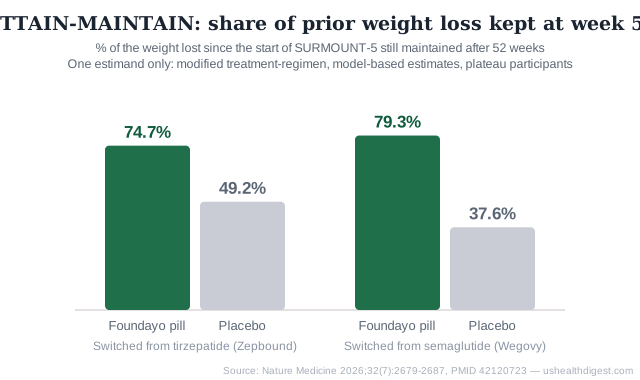
The first randomized trial of switching from an injectable GLP-1 to a daily pill for keeping lost weight off — ATTAIN-MAINTAIN, published in Nature Medicine — found that adults who moved from tirzepatide (Zepbound) to once-daily oral orforglipron (Foundayo) kept 74.7% of their prior weight loss at one year, versus 49.2% on placebo; those who moved from semaglutide (Wegovy) kept 79.3%, versus 37.6% on placebo. Those are model-based estimates under the trial's modified treatment-regimen estimand, in participants whose weight had plateaued. Two caveats carry real weight: the trial had no arm that stayed on the injectable, so it cannot say the pill matches the shot — and it was funded and run by Eli Lilly, orforglipron's maker. Whether a switch fits your situation is a conversation for your prescriber.
The trial: pill after injection, against placebo
ATTAIN-MAINTAIN (NCT06584916) is a phase 3b, double-blind trial run at 29 US sites. Everyone in it had just finished SURMOUNT-5 — the 72-week head-to-head trial of tirzepatide versus semaglutide covered in our Wegovy vs Zepbound comparison — and had lost at least 5% of body weight there. The paper reports that 376 people enrolled: 205 who had been on tirzepatide (cohort 1) and 171 who had been on semaglutide (cohort 2). Each cohort was randomized 3:2 to once-daily oral orforglipron — started at 12 mg and raised every 4 weeks toward 36 mg or the highest tolerated dose — or to placebo, for 52 weeks. Orforglipron was FDA-approved as Foundayo on April 1, 2026, with no restrictions on food or water intake; our guide to the oral GLP-1 pills covers where it sits among the tablets.
This matters for women in particular because most participants were women — 62.9% of the tirzepatide cohort and 68.4% of the semaglutide cohort, per the paper's baseline table — with a mean age around 48 and randomization stratified by sex.
The headline numbers — and the estimand they come from
The primary endpoint is a ratio: how much of the weight you lost between the start of SURMOUNT-5 and your switch was still gone at week 52. The primary analysis used the trial's modified treatment-regimen estimand — which counts outcomes regardless of whether people stayed on their assigned tablets — and was run in participants whose weight had plateaued. The paper defines that qualifier precisely: "a weight change of less than 5% between weeks 60 and 72 in the SURMOUNT-5 study." In plain terms, the primary question was asked of people whose weight had already leveled off on the injectable — the situation most switchers would actually be in.
| Group | Orforglipron (Foundayo) | Placebo | Difference (95% CI) |
|---|---|---|---|
| Switched from tirzepatide (cohort 1, N=205) | 74.7% | 49.2% | 25.5 points (14.5–36.5), P<0.001 |
| Switched from semaglutide (cohort 2, N=171) | 79.3% | 37.6% | 41.7 points (24.4–59.0), P<0.001 |
A worked example from those averages: a woman who lost 20 kg on Wegovy and switched to the pill would, at the trial's average, still be 15.9 kg down a year later (79.3% of 20 kg); on placebo, 7.5 kg down (37.6%). These are group averages from one trial's model, not predictions for any individual. Note what the placebo arms show, too: people who stopped the injectable and took a placebo tablet had regained roughly half to two-thirds of their loss within a year — consistent with the regain after stopping tirzepatide in SURMOUNT-4, which we unpack in our guide to stopping GLP-1s.
Lilly's kilogram framing is a different analysis
Eli Lilly's December 18, 2025 press release describes the same trial in kilograms, using a different analysis — the efficacy estimand, which estimates what happens if people stay on treatment. On that basis, the release says switchers from Wegovy "maintained their previously achieved weight loss with an average difference of 0.9 kg," and switchers from Zepbound an average difference of 5.0 kg. The gap makes sense given starting points the release reports: the Wegovy group entered the switch at 95.0 kg after starting SURMOUNT-5 at 113.5 kg (an 18.5 kg loss), while the Zepbound group entered at 90.9 kg from 115.8 kg (a 24.9 kg loss) — tirzepatide switchers simply had more loss to defend. In post-hoc analyses at 24 weeks — the last point before placebo participants could receive rescue therapy — weight change was −0.1 kg on the pill versus +9.4 kg on placebo in the Wegovy cohort, and +2.6 kg versus +9.1 kg in the Zepbound cohort. Because these company figures come from a different estimand than the primary results above, the two sets should not be compared side by side.
The second trial: dropping to a lower Zepbound dose instead
A later Lilly release, issued May 12, 2026 (an identical copy ran on PR Newswire), paired ATTAIN-MAINTAIN with a second maintenance trial: SURMOUNT-MAINTAIN (NCT06047548), a 112-week phase 3b trial of 441 participants. After 60 weeks of open-label tirzepatide at the maximum tolerated dose (10 or 15 mg), participants were randomized 3:3:2 to Zepbound 5 mg, Zepbound at their maximum tolerated dose, or placebo for 52 more weeks. Per the release — figures from a mixed-model analysis of the efficacy-estimand data set — those who stayed at the full dose preserved all of their prior weight loss at week 112, while stepping down to 5 mg maintained all but 5.6 kg on average; both beat placebo. Those kilogram figures are the company's efficacy-estimand numbers, a different estimand from the ATTAIN-MAINTAIN primary results — read them as a separate data point, not a head-to-head with the pill. The trial has since been peer-reviewed: the Lancet paper, published June 6, 2026, reports its primary results under a modified treatment-regimen estimand as percentage weight change across the whole 112 weeks — −21.9% at the maximum tolerated dose and −16.6% at 5 mg, versus −9.9% on placebo, P<0.0001 for both comparisons against placebo.
What this trial cannot tell you
The paper's own limitations section is the honest summary. It names "the lack of a comparator arm that included continuing injectable OMM and a trial duration of 1 year," along with US-only sites and a predominantly white study population. The missing arm is the one most readers want: nobody in this trial kept taking Wegovy or Zepbound, so the trial compares the pill to stopping entirely — not to staying the course. And the sponsorship is not incidental: the study was funded by Eli Lilly, which was "involved with study design, data collection, analysis, interpretation and writing of this report," and eight of the fourteen authors are Lilly employees. That does not invalidate a randomized, placebo-controlled result — but it is why the estimand fine print above matters, and why the numbers deserve the same scrutiny as any sponsor-run trial, including ATTAIN-1, the pill's original weight-loss trial (−11.2% at the top dose versus −2.1% on placebo at 72 weeks, treatment-regimen estimand).
Side effects of the switch
The most common adverse events on orforglipron were gastrointestinal — nausea, constipation, vomiting or diarrhea — mostly mild to moderate. Notably, people did not restart at zero tolerance: in the first 4 weeks after the switch, GI events (nausea, vomiting or diarrhea) occurred in 10.5% of the tirzepatide cohort and 9.5% of the semaglutide cohort, and the pill was started at 12 mg rather than the 1 mg used in people new to the drug. Per the paper's safety table, treatment discontinuation due to adverse events was 7.3% on orforglipron versus 2.5% on placebo in the tirzepatide cohort, and 4.8% versus 3.0% in the semaglutide cohort.
Questions for your prescriber
A switch from an injectable to a pill is a prescribing decision, and this page is evidence reporting, not medical advice. If you are considering it, useful questions to bring:
- Has my weight plateaued on my current dose? The trial's primary result applies to people whose weight changed less than 5% over their final 12 weeks on the injectable.
- Given that switchers from tirzepatide kept less of their loss on average than switchers from semaglutide, what should I expect from my starting point?
- Would staying on my injectable — or stepping down its dose — fit my goals better than switching drug classes entirely?
- How would we titrate the pill, and what is the plan if GI side effects return during the escalation weeks?
- What does the switch do to my coverage and out-of-pocket cost?
- What weight-regain threshold would make us revisit the decision?
Sources
- Aronne LJ, et al. Orforglipron for maintenance of body weight reduction: the double-blind, randomized phase 3b ATTAIN-MAINTAIN trial. Nature Medicine. 2026;32(7):2679–2687. PMID 42120723. Open-access full text (PubMed Central).
- ClinicalTrials.gov registry record, NCT06584916 (ATTAIN-MAINTAIN). National Library of Medicine.
- Eli Lilly and Company. Press release, December 18, 2025: orforglipron maintenance results (efficacy-estimand figures).
- Eli Lilly and Company. Press release, May 12, 2026: Foundayo and lower-dose Zepbound maintenance trials; identical distribution via PR Newswire.
- ClinicalTrials.gov registry record, NCT06047548 (SURMOUNT-MAINTAIN). National Library of Medicine.
- Horn DB, et al. Tirzepatide for maintenance of bodyweight reduction in people with obesity in the USA (SURMOUNT-MAINTAIN): a multicentre, double-blind, randomised, placebo-controlled trial. The Lancet. 2026;407(10545):2305–2318. PubMed 42119587.
- Aronne LJ, et al. Continued Treatment With Tirzepatide for Maintenance of Weight Reduction in Adults With Obesity: The SURMOUNT-4 Randomized Clinical Trial. JAMA. PubMed 38078870.
- Aronne LJ, et al. Tirzepatide as compared with semaglutide for the treatment of obesity (SURMOUNT-5). New England Journal of Medicine. PubMed 40353578.
- Wharton S, et al. Orforglipron, an Oral Small-Molecule GLP-1 Receptor Agonist for Obesity Treatment (ATTAIN-1). New England Journal of Medicine. PubMed 40960239.
- Eli Lilly and Company. Press release, April 1, 2026: FDA approval of Foundayo (orforglipron).