
Weight & Metabolic
Getting a GLP-1 covered through the sleep apnea indication: what SURMOUNT-OSA showed, and what plans require
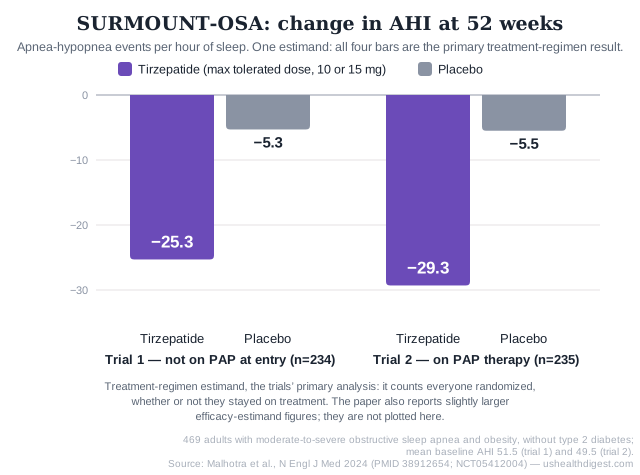
Yes, Zepbound (tirzepatide) can be covered for obstructive sleep apnea rather than for weight loss — but the sleep apnea indication is a separate approval with its own evidence and its own paperwork, not a loophole around a weight-loss exclusion. FDA approved the OSA use on December 20, 2024; the current label indicates it “in combination with a reduced-calorie diet and increased physical activity … to treat moderate to severe obstructive sleep apnea (OSA) in adults with obesity” — obesity is part of the indication, and nothing in it mentions positive airway pressure. The approval rests on two 52-week phase 3 trials (SURMOUNT-OSA, n=469) in which, under the primary treatment-regimen analysis, the apnea–hypopnea index fell by 25.3 and 29.3 events per hour on tirzepatide versus 5.3 and 5.5 on placebo. Whether a plan pays turns on the plan's own published criteria, and those diverge sharply: UnitedHealthcare's OSA-only program requires a failed or unusable PAP trial, while Cigna's national formulary policy requires no PAP step at all.
1. What FDA actually approved
Section 1 of the current Structured Product Label on DailyMed (version 38, published May 6, 2026) reads:
“ZEPBOUND is indicated in combination with a reduced-calorie diet and increased physical activity: to reduce excess body weight and maintain weight reduction long term in adults with obesity or adults with overweight in the presence of at least one weight-related comorbid condition. to treat moderate to severe obstructive sleep apnea (OSA) in adults with obesity.”
Three things follow. The sleep apnea use is a separate indication from weight management, which is why plans can review it under different rules. It still requires obesity; the label does not extend it to overweight. And it says nothing about positive airway pressure — it neither requires a PAP trial nor positions the drug as a replacement for PAP, so any PAP requirement comes from a plan, not from FDA. The only other text in Section 1 is a Limitations of Use line: coadministration with other tirzepatide-containing products, or with any GLP-1 receptor agonist, “is not recommended.” (For what the other approved GLP-1 labels cover, see what each label actually requires.)
The label carries one relevant caution: “The clinical studies for OSA did not evaluate the timing or appropriateness of PAP discontinuation in patients who were previously compliant with PAP therapy.” Nothing here is a reason to change or stop PAP; that belongs to the clinician managing your sleep apnea.
2. What SURMOUNT-OSA showed — and what it did not
The evidence is one publication reporting two independent, double-blind, randomized trials in the New England Journal of Medicine (Malhotra et al., PMID 38912654; NCT05412004; a published erratum followed on October 17, 2024). A total of 469 adults with moderate-to-severe OSA and obesity were randomized 1:1 to the maximum tolerated dose of tirzepatide (10 mg or 15 mg) or placebo for 52 weeks. Trial 1 (n=234) enrolled people not using PAP at baseline; trial 2 (n=235) people already on PAP.
The primary endpoint, reported under one estimand
The primary endpoint was the change from baseline in the apnea–hypopnea index — apneas and hypopneas per hour of sleep. The paper reports two estimands and states that “All results are reported with the use of the treatment-regimen estimand unless otherwise specified.” That analysis counts everyone randomized whether or not they stayed on treatment, and it is the one the FDA label reproduces. Under it:
- Trial 1 (not on PAP): AHI change −25.3 events/hour (95% CI −29.3 to −21.2) with tirzepatide versus −5.3 (95% CI −9.4 to −1.1) with placebo; estimated treatment difference −20.0 (95% CI −25.8 to −14.2).
- Trial 2 (on PAP): AHI change −29.3 events/hour (95% CI −33.2 to −25.4) versus −5.5 (95% CI −9.9 to −1.2); estimated treatment difference −23.8 (95% CI −29.6 to −17.9).
- Body weight, a key secondary endpoint under the same estimand: −17.7% versus −1.6% in trial 1, and −19.6% versus −2.3% in trial 2.
Mean baseline AHI was 51.5 events/hour in trial 1 and 49.5 in trial 2; mean BMI 39.1 and 38.7. The paper also reports larger efficacy-estimand figures (−27.4 and −30.4 events/hour); they answer a different question and must not be set beside the numbers above.
The honest limitations
The authors list them plainly. “First, the design and shorter duration of the current trials does not support the assessment of long-term cardiovascular outcomes” — not powered for heart attacks, strokes or death; the SURMOUNT-MMO outcomes trial (active, not recruiting; estimated primary completion October 2027) is designed to answer that. They also did not test beyond 52 weeks, excluded people without obesity, and were not designed to investigate whether treatment changes PAP adherence.
One limitation matters specifically to our readers: women were a minority of participants — 32.9% of trial 1 and 27.7% of trial 2. Enrollment of men was capped at 70% “to ensure adequate representation of women,” who the authors say “typically represent a minority in obstructive sleep apnea trials”; that is better than the field's norm, but roughly seven in ten participants were still men, and the label states only that AHI reduction was seen “irrespective of age, sex, ethnicity, baseline BMI, or baseline OSA severity,” without publishing a sex-stratified effect size.
3. What “covered for sleep apnea” actually requires from a plan
This is decided document by document. Two large national payers publish their criteria in full, and they do not agree. (UnitedHealthcare's version below takes effect September 1, 2026, days after we publish.)
| Document | Sleep study / AHI | BMI | PAP requirement | Other gates | Approval length |
|---|---|---|---|---|---|
| FDA-approved label (Zepbound SPL v38) May 6, 2026 |
“moderate to severe” OSA; no test or threshold specified | “adults with obesity”; no number in Section 1 | None | Used “in combination with a reduced-calorie diet and increased physical activity” | Not applicable |
| UnitedHealthcare Pharmacy, 2026 P 1475-3 Effective September 1, 2026 |
Sleep study and AHI, REI or RDI above 15 events per hour | BMI ≥ 30 kg/m2 | Yes. Continued OSA symptoms despite PAP adherence (“≥ 4 hours of use per night for ≥ 70 percent of nights”) or not a PAP candidate | Age 18+; one previous unsuccessful dietary effort; no diabetes or HbA1c > 6.5%; not predominantly central or mixed apnea; no planned OSA or obesity surgery; counseling attestations; sleep, pulmonary, ENT or OSA-experienced physician involvement | 6 months initially |
| Cigna National Formulary PA policy Reviewed July 9, 2025; revised April 15, 2026 |
Sleep study showing moderate-to-severe OSA and AHI ≥ 15 events per hour | BMI ≥ 30 kg/m2 at baseline, before any GLP-1 | None. PAP appears in the policy only in its summary of the trials, not in the criteria | Age 18+; no central sleep apnea or Cheyne-Stokes respiration; used with behavioral modification and a reduced-calorie diet | 1 year |
Two payers, one indication, materially different hurdles — and two payers are not all payers. Get your own plan's policy document by name and read the criteria.
Does the OSA indication get you around a weight-loss exclusion?
Sometimes — and it is a plan-design question, not a clinical one. UnitedHealthcare's program states: “Medications for the purpose of weight loss are typically a benefit exclusion. The program allows for coverage of Zepbound for obesity with obstructive sleep apnea.” Cigna maintains a separate Benefit Exclusion Overrides policy (revised January 2, 2026) whose stated purpose includes authorizing “Zepbound to treat moderate to severe obstructive sleep apnea in a patient with obesity”.
Both companies print the caveat. Cigna's policies state that “a customer's benefit plan document always supersedes the information in the coverage policies”; UnitedHealthcare's program is footnoted “member specific benefit plan coverage may also impact coverage criteria.” If an employer bought a plan that excludes the drug outright rather than excluding the weight-loss use, meeting every clinical criterion above will not create a benefit the plan document does not contain. Our GLP-1 insurance coverage guide covers how to find out which you have.
4. Medicare, specifically
Medicare Part D is barred by statute from covering drugs used for weight loss. In its December 10, 2024 proposed rule, CMS set out its reading: the covered-Part D-drug definition excludes “[a]gents when used for anorexia, weight loss, or weight gain,” and since 2006 CMS has read that “to mean that a drug when used for weight loss, even when not used for cosmetic purposes, is excluded from the definition of covered Part D drug.” But the exclusion is written around the use, not the molecule. The same rule records that CMS issued guidance on March 20, 2024 “clarifying that AOMs that receive FDA approval for an additional indication other than chronic weight management can be considered a Part D drug for that specific use,” and that “under current policy, AOMs are coverable under Part D for individuals with obesity or overweight only if the drug is being prescribed for another condition (other than weight loss or chronic weight management) for which the drug has an FDA-approved indication” (CMS-4208-P). Moderate-to-severe OSA in adults with obesity became exactly such an indication ten days after that rule published.
CMS's proposal to reinterpret the statute and cover anti-obesity medications for obesity itself was not adopted: the final rule of April 15, 2025 states, “We also do not intend to finalize the following provisions from the proposed rule: … Part D Coverage of Anti-Obesity Medications (AOMs) and Application to the Medicaid Program.”
Medicare's consumer page makes the consequence clear: describing the temporary Medicare GLP-1 Bridge, medicare.gov lists among people not eligible those who “Have type 2 diabetes, moderate-to-severe sleep apnea, or fatty liver disease (but your Part D plan might cover your GLP-1s).” CMS says the same thing to plans directly. Its June 10, 2026 memo to Part D sponsors gives as its own example that beneficiaries “prescribed Zepbound® for the treatment of moderate to severe obstructive sleep apnea in adults with obesity … should continue to receive coverage through Medicare Part D.” Whether a given plan carries the drug is a plan-by-plan formulary question — see our walkthrough of the Medicare GLP-1 Bridge.
5. Questions to ask, and what an appeal usually needs
For your prescriber:
- Do I have a sleep study on file, what AHI, REI or RDI does it record, and on what date?
- Does that report classify my OSA as moderate or severe, in those words?
- Is a pre-GLP-1 baseline BMI of 30 or above documented in my chart?
- Do my records show predominantly central or mixed apnea, or Cheyne-Stokes respiration — an exclusion in both policies above?
- If I use PAP, can my adherence data be pulled and my symptoms documented; if I cannot use PAP, is the reason recorded?
- Does the OSA indication change anything about how my sleep apnea itself is managed?
For your plan (ask by name, in writing):
- “Which policy document governs tirzepatide for obstructive sleep apnea on my plan? Please send me the policy number and effective date.”
- “Does my benefit document exclude weight-management drugs as a category, and does that exclusion apply when the drug is prescribed for OSA?”
- “Is a PAP trial or documented PAP intolerance required, and how is adherence defined?”
- “How long is an initial approval, and what evidence is needed at reauthorization?”
Both policies re-test you later: UnitedHealthcare's reauthorization asks people not on PAP for a documented AHI, RDI or REI decrease (50% once past 52 weeks) plus at least 10% weight loss from baseline; Cigna's continuation asks for at least 10% weight loss and prescriber-attested stability in OSA signs or symptoms. A renewal denial is usually a documentation gap, closed with the same sleep study report, PAP download, chart notes and weights the initial request already used. Our guide to appealing a GLP-1 denial covers internal appeals, external review and Part D deadlines; our Wegovy versus Zepbound comparison covers both drugs, of which only tirzepatide holds the OSA indication.
Common questions
Can you get Zepbound covered for sleep apnea?
Yes, in principle. Zepbound holds a separate FDA approval for moderate to severe obstructive sleep apnea in adults with obesity, granted on December 20, 2024, and health plans that exclude weight loss drugs may still cover it for that indication. Coverage is not automatic: plans publish their own prior authorization criteria, which typically require a sleep study, an apnea hypopnea index above 15 events per hour, and a body mass index of 30 or higher.
Do you have to try CPAP first?
It depends entirely on the plan. The FDA approved label sets no positive airway pressure requirement. UnitedHealthcare's obstructive sleep apnea program does require either continued symptoms despite documented PAP adherence or evidence that the patient is not a PAP candidate, while Cigna's national formulary policy contains no PAP requirement in its criteria.
Sources
- DailyMed — ZEPBOUND (tirzepatide), current Structured Product Label v38, May 6, 2026 (Sections 1, 6.1 and 14.2).
- FDA press announcement, December 20, 2024 — FDA approves first medication for obstructive sleep apnea.
- Malhotra A, et al. Tirzepatide for the treatment of obstructive sleep apnea and obesity. N Engl J Med 2024;391(13):1193–1205 (PMID 38912654); full text at PMC11598664; erratum, N Engl J Med 2024;391(15):1464.
- ClinicalTrials.gov: SURMOUNT-OSA, SURMOUNT-MMO.
- UnitedHealthcare Pharmacy, program 2026 P 1475-3: Zepbound — Obstructive Sleep Apnea Only, effective September 1, 2026.
- Cigna National Formulary: Weight Loss — GLP-1 Agonists Prior Authorization Policy, revised April 15, 2026.
- Cigna National Formulary: Weight Loss — GLP-1 Agonists Benefit Exclusion Overrides Policy, revised January 2, 2026.
- CMS proposed rule, December 10, 2024 (CMS-4208-P) and final rule, April 15, 2025 (CMS-4208-F), Federal Register.
- CMS memo to Part D sponsors, June 10, 2026 — Medicare GLP-1 Bridge: Expectations and FAQs.
- Medicare.gov — weight-loss drugs and the Medicare GLP-1 Bridge.
General health journalism, not medical or insurance advice, and not a recommendation to start, stop or change any medication or to alter the use of positive airway pressure therapy. Coverage rules change; verify against your plan's current policy document.