
Weight & Metabolic Health
GLP-1 drugs and fatty liver disease: what is actually FDA-approved for MASH
One GLP-1 has a US liver indication: on August 15, 2025 the FDA gave Wegovy (semaglutide 2.4 mg) an accelerated approval for "noncirrhotic metabolic dysfunction-associated steatohepatitis (MASH) ... with moderate to advanced liver fibrosis (consistent with stages F2 to F3 fibrosis) in adults", on the ESSENCE trial. Tirzepatide (Zepbound) does not — its label, updated April 22, 2026, lists only weight management and sleep apnea. The key word is accelerated: the approval rests on biopsy findings, a surrogate for what matters — cirrhosis, cancer, transplant, death — and the label says continued approval "may be contingent upon the verification and description of clinical benefit in a confirmatory trial."
What MASLD and MASH are, in plain English
The names changed recently, which is why the literature confuses. In 2023 a Delphi panel replaced "non-alcoholic fatty liver disease" with metabolic dysfunction-associated steatotic liver disease (MASLD) and redefined it to require at least one of five cardiometabolic risk factors. NAFLD became MASLD; NASH became MASH. A separate category, MetALD, covers those with MASLD who drink above defined weekly thresholds.
MASLD is fat in the liver. MASH is the aggressive subtype: fat plus inflammation and cell injury. Scarring runs from F0 (no fibrosis) to F4 (cirrhosis). Both approved drugs stop at F3.
It is usually silent. NIDDK says NAFLD/MASLD is "usually … a silent disease with few or no symptoms," and that "you may not have symptoms even if you develop cirrhosis." The FDA estimates about 6% of US adults — 14.9 million people — have MASH, most undiagnosed.
The approvals table
| Drug (brand) | Approval date | MASH indication | Type | Pivotal trial |
|---|---|---|---|---|
| Resmetirom (Rezdiffra), oral | March 14, 2024 | "Noncirrhotic MASH ... with moderate to advanced liver fibrosis (consistent with stages F2 to F3 fibrosis)"; avoid in decompensated cirrhosis | Accelerated | MAESTRO-NASH (PMID 38324483) |
| Semaglutide 2.4 mg (Wegovy), weekly injection | August 15, 2025 | "Noncirrhotic ... MASH ... with moderate to advanced liver fibrosis (consistent with stages F2 to F3 fibrosis) in adults" | Accelerated | ESSENCE part 1 (PMID 40305708) |
| Tirzepatide (Zepbound) | — | None. Label lists weight reduction and obstructive sleep apnea only | — | SYNERGY-NASH is phase 2 (PMID 38856224) |
The MASH indication sits on the same Wegovy label as weight and cardiovascular risk reduction — an added indication on the same label, not a separate product, not a separate product — and is restricted to the injection at 2.4 mg weekly; Wegovy tablets do not carry it.
The two co-primary endpoints, and what ESSENCE showed
MASH trials use two biopsy endpoints read together, because a drug could calm inflammation while scarring quietly advanced: resolution of steatohepatitis without worsening of fibrosis, and improvement in fibrosis without worsening of steatohepatitis. The label defines resolution by MASH Clinical Research Network criteria: lobular inflammation 0 to 1, ballooning 0, any steatosis.
ESSENCE (NCT04822181) is an ongoing 240-week phase 3 trial that randomised 1,197 patients with biopsy-defined MASH and fibrosis stage 2 or 3, 2:1 to weekly semaglutide 2.4 mg or placebo. The FDA approved on part 1: a planned week-72 interim analysis in the first 800. Every number below comes from that one analysis of all 800 randomised part-1 participants, with missing biopsies handled by reference-based multiple imputation and estimates pooled by a Mantel-Haenszel method stratified on diabetes status and fibrosis stage. That is a randomisation-based analysis, not a completers analysis, and the only estimand quoted here for this trial.
| Endpoint at week 72 | Semaglutide 2.4 mg | Placebo | Difference (95% CI) |
|---|---|---|---|
| Resolution of steatohepatitis, no worsening fibrosis (co-primary) | 62.9% | 34.3% | 28.7 points (21.1–36.2), P<0.001 |
| Fibrosis reduction, no worsening steatohepatitis (co-primary) | 36.8% | 22.4% | 14.4 points (7.5–21.3), P<0.001 |
| Both, together (secondary) | 32.7% | 16.1% | 16.5 points (10.2–22.8), P<0.001 |
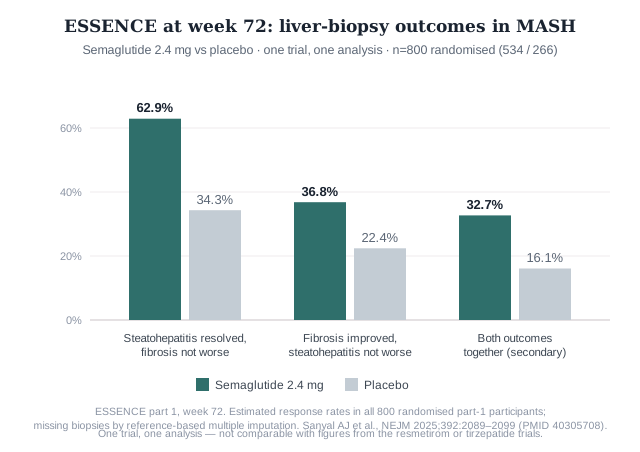
Note the placebo column: a third met the resolution endpoint — lifestyle care, regression to the mean and biopsy sampling variability all move it. Mean weight change was −10.5% versus −2.0% on placebo; gastrointestinal events were more common on the drug (side effects in women).
Resmetirom: the comparator that got there first
Rezdiffra was the first MASH drug of any class, approved March 14, 2024 — also accelerated, also noncirrhotic F2–F3. It is not a GLP-1 but a daily oral thyroid hormone receptor-beta agonist. In MAESTRO-NASH (NCT03900429), within a prespecified 966-patient primary analysis population at week 52, MASH resolution without worsening fibrosis occurred in 25.9% (80 mg) and 29.9% (100 mg) versus 9.7% on placebo; fibrosis improvement in 24.2% and 25.9% versus 14.2%. Different trial, timepoint and population (F1B included) — not comparable with ESSENCE, and we found no registered trial comparing the two drugs head-to-head.
Tirzepatide: real data, no approval
SYNERGY-NASH (NCT04166773) was explicitly "a phase 2, dose-finding" trial in 190 participants with F2–F3 MASH. Among the 157 with evaluable week-52 biopsies — missing values imputed as if they followed placebo — MASH resolution without worsening fibrosis reached 44%, 56% and 62% at 5, 10 and 15 mg versus 10% on placebo. Not comparable to ESSENCE: different phase, size, imputation rule.
What does not exist is an approval — but a phase 3 programme does. As of August 18, 2026 tirzepatide has no MASH indication on any US label, and a ClinicalTrials.gov query that day (intervention "tirzepatide", condition "steatohepatitis") returned two studies: SYNERGY-NASH, and SYNERGY-Outcomes (NCT07165028), an Eli Lilly phase 3 master protocol of tirzepatide and retatrutide against placebo in 4,500 adults with MASLD, recruiting since October 2025, with primary completion scheduled for August 2030. SYNERGY-Outcomes enrols on non-invasive criteria rather than biopsy, and its primary endpoint is time to a first major adverse liver outcome, not histology — so it is not a biopsy-and-histology trial of the kind that produced the two existing approvals. Searches are listed below. On the indications both drugs do share, see Wegovy vs Zepbound.
Why "accelerated approval" is the key phrase
Both approvals are accelerated. The FDA describes the pathway as letting a therapy for a serious condition reach market earlier "based on a surrogate endpoint (e.g., a laboratory measure) with additional data required after approval to confirm the effect of the therapy on a clinically meaningful endpoint." The surrogate is what a pathologist sees on a slide; the outcomes that matter are what ESSENCE's remaining 240 weeks and Rezdiffra's confirmatory work must test. Improved histology is a reasonable bet on better outcomes, not proof.
What this means for women
The pattern is not "women get more of it." A meta-analysis of 54 studies (62,239 people in the prevalence analysis) found women had a 19% lower risk of NAFLD than men (RR 0.81; 95% CI 0.68–0.97), a similar risk of NASH, and — once disease was established — a 37% higher risk of advanced fibrosis (RR 1.37; 95% CI 1.12–1.68). In populations averaging 50 and older that rose to RR 1.56 (1.36–1.80); the difference faded in younger ones. Fewer women get it, but those who do are likelier to carry the scarring that matters, and the gap opens in midlife. Heterogeneity was high — read these as direction, not exact quantity.
A 2026 narrative review finds the same shape — higher MASLD prevalence in men than in premenopausal women, the disparity diminishing after menopause — and flags a trap: women have lower ALT and AST across populations, which the authors say may contribute to underdiagnosis. The same review also reports that men show faster fibrosis progression and higher hepatocellular carcinoma incidence, so the sex picture does not run uniformly in one direction. Being narrative rather than pooled, we quote its directions, not its effect sizes.
The stakes show in transplant data. In an OPTN cohort of every US adult liver transplant from 2010 to 2019, the leading cause among women transplanted in 2019 was NAFLD, at 26.8% — ahead of alcohol-associated liver disease (21.1%) and hepatitis C (13.1%); among men, alcohol-associated disease led. A 2019 snapshot, not a current figure.
PCOS is the other signal: a meta-analysis of 23 studies and 7,148 participants found premenopausal women with PCOS had 2.5-fold higher odds of NAFLD (pooled OR 2.49; 95% CI 2.20–2.82), BMI the dominant cofactor — see GLP-1s and PCOS in women and GLP-1s after 40.
One limit: ESSENCE part 1 was 57% female, median age 57, so women were well represented. The publication does report subgroup analyses of both co-primary endpoints by sex, stating that responses "according to age, sex, body-mass index, diabetes diagnosis, and fibrosis stage were consistent with those in the overall trial population" — in supplementary figures, not as sex-specific percentages in the main text. The Wegovy label itself reports no sex-stratified efficacy. The honest reading: no signal that the drug works differently in women, and no published number to quote for women specifically.
How anyone finds out they have it
This is what clinicians use, not thresholds to act on. Per NIDDK, a doctor "may suspect you have NAFLD if your blood test shows increased levels of the liver enzymes" ALT and AST, and "may use the results of routine blood tests to calculate special scores, such as the FIB-4 or APRI." Elastography, including the vibration-controlled transient form, helps "determine if you have advanced liver fibrosis." Biopsy is the reference standard — "the only test that can prove a diagnosis of NASH" — reserved for those likely to have advanced fibrosis. ESSENCE participants had a median baseline FIB-4 of 1.6 alongside a qualifying biopsy; the 2023 AASLD guidance sets out the sequencing (Hepatology 2023;77:1797-1835).
Questions for your prescriber
This is evidence reporting, not medical advice.
- Is there evidence of liver fat or fibrosis in my results — enzymes, FIB-4, elastography?
- The indication covers F2–F3 without cirrhosis. Am I inside it, outside it, or unknown?
- If I already take a GLP-1 for weight, would my dose or monitoring change?
- The approval is accelerated, based on biopsy findings. What would we monitor?
- Zepbound has no MASH indication, though tirzepatide is in a phase 3 liver-outcomes trial. Does that change anything about how my liver is monitored?
- Does my plan treat a liver indication differently from a weight one?
What these approvals do not mean
They do not mean a drug replaces the rest of care. Both labels tie the indication to lifestyle — Wegovy's to reduced-calorie diet and increased physical activity, Rezdiffra's to diet and exercise — and ESSENCE ran semaglutide on top of standard care, not instead.
They do not mean hard outcomes are settled: accelerated approval is by construction approval on a surrogate. They do not extend to cirrhosis — F4 is outside both. And a new indication is not a formulary decision: whether a plan pays is a separate fight, covered in GLP-1 insurance coverage in 2026. See also our 2026 GLP-1 statistics and GLP-1 FAQ for women.
Absence claims and how we tested them
Five statements above claim something does not exist. Each is scoped to what we actually searched, on August 18, 2026. One: tirzepatide has no FDA MASH indication — the current Zepbound label on DailyMed (SPL version 38, effective April 22, 2026) names only weight reduction and obstructive sleep apnea, and contains no occurrence of "MASH" or "steatohepatitis". Two: no registered phase 3 trial of tirzepatide uses a biopsy-defined MASH population with a histologic primary endpoint — the ClinicalTrials.gov query above returns SYNERGY-NASH (phase 2, completed) and SYNERGY-Outcomes (phase 3, recruiting), the latter enrolling on non-invasive criteria with a liver-outcomes endpoint. We do not claim tirzepatide is absent from phase 3 in this disease; it is not. Three: no third drug holds a US MASH indication — FDA's two MASH approval announcements (Rezdiffra, March 14, 2024; Wegovy, August 15, 2025) remain the only ones, and obeticholic acid, the only other agent to reach an FDA decision in this disease, received complete response letters in 2020 and 2023 and remains approved only for primary biliary cholangitis. Four: a ClinicalTrials.gov query for intervention "resmetirom" returned 22 studies, none with a semaglutide comparator arm — hence no registered head-to-head. Five: the Wegovy label reports no sex-stratified efficacy for the MASH indication (we read section 14.4 in full). The ESSENCE publication, by contrast, does report both co-primary endpoints by sex — see above.
Sources
- U.S. Food and Drug Administration. FDA Approves Treatment for Serious Liver Disease Known as "MASH" — Wegovy (semaglutide) accelerated approval, August 15, 2025.
- DailyMed. WEGOVY (semaglutide) injection and tablet — current prescribing information. National Library of Medicine; SPL updated June 18, 2026. Indications, MASH dosing, and Clinical Studies section 14.4.
- Sanyal AJ, Newsome PN, Kliers I, et al.; ESSENCE Study Group. Phase 3 Trial of Semaglutide in Metabolic Dysfunction-Associated Steatohepatitis. New England Journal of Medicine. 2025;392(21):2089-2099. PubMed 40305708.
- ClinicalTrials.gov registry record, NCT04822181 (ESSENCE). National Library of Medicine.
- Newsome PN, Sanyal AJ, Neff G, et al. Semaglutide 2.4 mg in Participants With Metabolic Dysfunction-Associated Steatohepatitis: Baseline Characteristics and Design of the Phase 3 ESSENCE Trial. Alimentary Pharmacology & Therapeutics. 2024. Open-access full text (PubMed Central).
- U.S. Food and Drug Administration. FDA Approves First Treatment for Patients with Liver Scarring Due to Fatty Liver Disease — Rezdiffra (resmetirom), March 14, 2024.
- DailyMed. REZDIFFRA (resmetirom) tablets — current prescribing information. National Library of Medicine; SPL updated July 29, 2026.
- Harrison SA, Bedossa P, Guy CD, et al.; MAESTRO-NASH Investigators. A Phase 3, Randomized, Controlled Trial of Resmetirom in NASH with Liver Fibrosis. New England Journal of Medicine. 2024;390(6):497-509. PubMed 38324483. Registry record: NCT03900429.
- DailyMed. ZEPBOUND (tirzepatide) injection — current prescribing information. National Library of Medicine; label updated April 22, 2026.
- Loomba R, Hartman ML, Lawitz EJ, et al. Tirzepatide for Metabolic Dysfunction-Associated Steatohepatitis with Liver Fibrosis. New England Journal of Medicine. 2024;391(4):299-310. PubMed 38856224. Registry record: NCT04166773 (SYNERGY-NASH, phase 2).
- Rinella ME, Lazarus JV, Ratziu V, et al.; NAFLD Nomenclature consensus group. A multisociety Delphi consensus statement on new fatty liver disease nomenclature. Hepatology. 2023;78(6):1966-1986. PubMed 37363821.
- Balakrishnan M, Patel P, Dunn-Valadez S, et al. Women Have a Lower Risk of Nonalcoholic Fatty Liver Disease but a Higher Risk of Progression vs Men: A Systematic Review and Meta-analysis. Clinical Gastroenterology and Hepatology. 2021;19(1):61-71.e15. PubMed 32360810.
- Sex Differences in Metabolic Dysfunction-Associated Steatotic Liver Disease (MASLD): Epidemiology, Pathophysiology, and Clinical Implications. Journal of Clinical and Experimental Hepatology. 2026. PubMed 42022177.
- Shengir M, Chen T, Guadagno E, et al. Non-alcoholic fatty liver disease in premenopausal women with polycystic ovary syndrome: A systematic review and meta-analysis. JGH Open. 2021;5(4):434-445. Open-access full text (PubMed Central).
- Causes and trends in liver disease and hepatocellular carcinoma among men and women who received liver transplants in the U.S., 2010-2019. PLoS One. 2020;15(9):e0239393. Open-access full text (PubMed Central).
- National Institute of Diabetes and Digestive and Kidney Diseases. Definition & Facts of NAFLD & NASH and Diagnosis of NAFLD & NASH.
- Rinella ME, Neuschwander-Tetri BA, Siddiqui MS, et al. AASLD Practice Guidance on the clinical assessment and management of nonalcoholic fatty liver disease. Hepatology. 2023;77(5):1797-1835. PubMed 36727674.
- ClinicalTrials.gov registry record, NCT07165028 (SYNERGY-Outcomes: a master protocol of multiple agents in adults with MASLD; Eli Lilly; phase 3; recruiting). National Library of Medicine.
- National Institute of Diabetes and Digestive and Kidney Diseases. NAFLD & NASH: Symptoms & Causes.