
News & Trends
Aleniglipron enters phase 3: what the next GLP-1 pill contender has actually shown
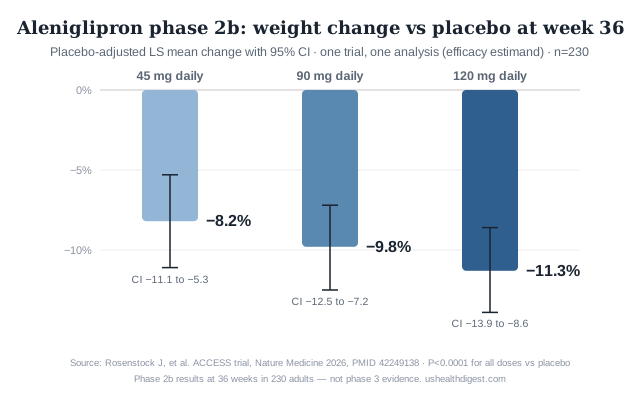
Structure Therapeutics said on August 6 that the first patients have been dosed in its phase 3 ACCOMPLISH program for aleniglipron, a once-daily oral GLP-1 pill, per the company's second-quarter release. The evidence behind the move is a 230-person, 36-week phase 2b trial, published in Nature Medicine in June: placebo-adjusted weight loss of 8.2% at the 45 mg dose, 9.8% at 90 mg and 11.3% at 120 mg. Those are promising phase 2 numbers under a favorable analysis — not phase 3 evidence, and not a reason to expect this pill in pharmacies soon. The two phase 3 trials, in up to 3,600 and 1,100 adults, run 76 weeks and are not expected to finish their primary phase before September 2028.
What was announced
In its Q2 2026 results release — filed the same day as an exhibit to an SEC 8-K — Structure Therapeutics said the first patients have been dosed in ACCOMPLISH, aleniglipron's pivotal program. It has two trials, both randomized and placebo-controlled: ACCOMPLISH-1, up to 3,600 adults with obesity or overweight plus a weight-related health condition, and ACCOMPLISH-2, up to 1,100 adults with obesity or overweight and type 2 diabetes. Per the registry records, both began in mid-July, both measure percent change in body weight at week 76 as the primary endpoint, and both list an estimated primary completion of September 2028. Participants are randomized to 45 mg, 90 mg or 180 mg daily, or placebo, starting at 2.5 mg and stepping up every four weeks — a gentler on-ramp than phase 2b's 5 mg start, chosen, per the company's June release, after its end-of-phase-2 meeting with the FDA.
For readers keeping count of the pill field: two GLP-1 pills are already FDA-approved for weight management — oral Wegovy (semaglutide 25 mg) and Foundayo (orforglipron), covered in our guide to the oral GLP-1 pills — and Novo Nordisk's tablet form of amycretin (zenagamtide, a GLP-1/amylin dual agonist) has a phase 3 trial registered but not yet started, with an estimated September 2026 launch. That makes aleniglipron the third GLP-1-based pill for obesity to reach the pivotal stage or the market in the US, with zenagamtide queued up as the fourth.
What the phase 2b trial showed at 36 weeks
The ACCESS trial (NCT06693843), published online in Nature Medicine on June 5, 2026, randomized 230 US adults with obesity, or overweight plus at least one weight-related condition, to once-daily aleniglipron — titrated every four weeks toward 45, 90 or 120 mg — or placebo, for 36 weeks. The population is relevant to this readership: 54% women, with a mean BMI of 39.5. The primary endpoint was met at every dose. Placebo-adjusted least-squares mean weight change at week 36 was −8.2% (95% CI −11.1 to −5.3) at 45 mg, −9.8% (−12.5 to −7.2) at 90 mg and −11.3% (−13.9 to −8.6) at 120 mg, P<0.0001 for every dose versus placebo — with no apparent plateau in the weight curves when the blinded period ended.
One line of fine print matters more than the rest. The paper's primary analysis uses an efficacy estimand: a mixed model in which data collected after someone stopped the drug, started another obesity medication or had bariatric surgery were set to missing. That estimates what the drug does when taken — a legitimate question, but a systematically friendlier one than the treatment-policy-type analyses that anchor the approved pills' pivotal results, which count everyone randomized no matter what happened next. Roughly a quarter of participants did not complete the 36 weeks (completion ranged from 73.3% to 78.1% across aleniglipron arms). Keep that in mind before setting these numbers beside anything else.
Tolerability, and who ran the trial
Per the paper, gastrointestinal side effects were the dominant issue, as everywhere in this drug class: generally mild to moderate, decreasing in frequency over time, with little to no recurrence of vomiting when the drug was restarted after permitted dose interruptions. Treatment-related discontinuations were 10.4% across aleniglipron arms. Notably for a small-molecule (non-peptide) pill, the paper reports no events of drug-induced liver injury. Standard disclosure applies: the trial was run by the company — seven authors are Structure Therapeutics employees, and most of the academic authors report fees or research funding from it, per the paper's competing-interests statement.
A correction is on the record
The paper carries a publisher correction, issued June 24, 2026 — a publisher's error, not the authors'. It states that in the version initially published, a figure listed the 120 mg arm's LS mean change as −12.1 where it should read −12.7, and that another figure was missing data in one panel and arrows in its vomiting panels. The primary placebo-adjusted results quoted above are unaffected.
The 16.2% figure: a company number, quarantined on purpose
Structure's August release also says participants in the ongoing open-label extension of ACCESS showed "continued weight loss beyond 36 weeks and up to 16.2% at 44 weeks." We are deliberately keeping that figure away from the trial results above, because it is a different kind of number: it comes from an uncontrolled extension in which everyone knows they are on the drug, it has no placebo arm to adjust against, it is a "up to" figure rather than an average across doses, and the release states no analysis method for it. The extension runs to 72 weeks of total treatment — including exposure to the 180 mg dose that phase 3 will test — with topline data the company expects in Q3 2026. Until then, 16.2% is a company claim about an open-label study, not trial evidence of the kind quoted above.
Where it sits against the pills you can already get
No trial has compared aleniglipron with oral Wegovy or Foundayo, so there is no evidence-based ranking — the table below exists to show how different the studies are, not to crown a winner.
| Pill | Status | Trial, population, duration | Placebo-adjusted or vs-placebo result, with estimand |
|---|---|---|---|
| Aleniglipron 120 mg | Investigational; phase 3 dosing began 2026 | ACCESS, phase 2b, 230 adults with obesity/overweight, 36 weeks | −11.3% placebo-adjusted (95% CI −13.9 to −8.6); efficacy (hypothetical) estimand, MMRM |
| Oral Wegovy (semaglutide 25 mg) | Approved; in US pharmacies since Jan 2026 | OASIS 4, phase 3, 307 adults with obesity/overweight, 64 weeks | −13.6% vs −2.2% on placebo; treatment-policy estimand (counts everyone randomized) |
| Foundayo (orforglipron 36 mg) | Approved April 1, 2026 | ATTAIN-1, phase 3, 3,127 adults with obesity, 72 weeks | −11.2% vs −2.1% on placebo; treatment-regimen estimand (counts everyone randomized) |
For what the two approved pills showed and how to choose between them, see our oral GLP-1 pills guide and the first pill-versus-pill trial.
Why the phase 2 numbers deserve a discount
Three structural reasons, before any judgment about the drug itself:
- Size. ACCESS randomized 230 people across four groups; ACCOMPLISH-1 alone plans up to 3,600. Small trials carry wide confidence intervals — the 120 mg result is compatible with anything from 8.6% to 13.9%.
- Duration and analysis. 36 weeks, under an estimand that sets dropouts' later data to missing, will be replaced by 76 weeks in a larger population. The class precedent is instructive: orforglipron's phase 2 trial reported mean weight change of up to −14.7% at 36 weeks versus −2.3% on placebo in 272 people, while its 3,127-person phase 3 reported −11.2% versus −2.1% at 72 weeks under a stricter analysis. Different durations and estimands make that an illustration rather than a measurement — but the direction of travel from phase 2 headline to phase 3 primary result is routinely downward.
- The top phase 3 dose is new. The blinded trial tested up to 120 mg; phase 3 adds a 180 mg arm whose longer-term evidence so far comes from the open-label extension, per the company's release.
What this means if you are weighing a pill now
Aleniglipron is an investigational drug: not FDA-approved, and not legally available outside its trials. With primary completion of both phase 3 trials estimated for September 2028, it changes nothing about a prescribing decision in 2026 — the approved options and their evidence are in our pills guide. Anyone selling "aleniglipron" or "GSBR-1290" today is selling an unapproved research chemical. If the drug's trajectory matters to you, the two things to watch are the 72-week open-label extension data the company expects this quarter, and whether the phase 3 program enrolls a population as heavily female as ACCESS's 54%. As with every drug in this class, GLP-1s should not be used in pregnancy or while trying to conceive; our GLP-1 FAQ for women covers that and the other questions worth bringing to a prescriber.
Sources
- Rosenstock J, Lingvay I, Ryan D, et al. Oral small molecule GLP-1 receptor agonist aleniglipron in people with overweight or obesity: a randomized, double-blind, placebo-controlled phase 2b trial. Nature Medicine, published online June 5, 2026. PubMed 42249138.
- Publisher Correction to the above. Nature Medicine, June 24, 2026. PubMed 42343118.
- ClinicalTrials.gov registry record, NCT06693843 (ACCESS, phase 2b). National Library of Medicine.
- Structure Therapeutics. Second Quarter 2026 Financial Results and Recent Highlights, August 6, 2026; identical text filed as Exhibit 99.1 to Form 8-K, SEC.
- Structure Therapeutics. Announcement of the Nature Medicine publication, June 5, 2026.
- ClinicalTrials.gov registry record, NCT07654361 (ACCOMPLISH-1, phase 3). National Library of Medicine.
- ClinicalTrials.gov registry record, NCT07654374 (ACCOMPLISH-2, phase 3). National Library of Medicine.
- ClinicalTrials.gov registry record, NCT07720271 (AMAZE 9, zenagamtide tablets, phase 3). National Library of Medicine.
- Wharton S, Lingvay I, et al. Oral Semaglutide at a Dose of 25 mg in Adults with Overweight or Obesity (OASIS 4). NEJM 2025. PubMed 40934115.
- Wharton S, Aronne LJ, et al. Orforglipron, an Oral Small-Molecule GLP-1 Receptor Agonist for Obesity Treatment (ATTAIN-1). NEJM 2025. PubMed 40960239.
- Wharton S, Blevins T, et al. Daily Oral GLP-1 Receptor Agonist Orforglipron for Adults with Obesity (phase 2). NEJM 2023. PubMed 37351564.
This article is general information, not medical advice; discuss any weight-loss medication decision with a licensed clinician who knows your health history.