News & Trends
Wednesday's solar eclipse: how to watch the partial phase without damaging your eyes
Eclipse-day update, August 12. The partial eclipse crosses the US today, beginning around midday and lingering into midafternoon farther east, per NASA. Nothing in the safety guidance below has changed: there is no safe naked-eye moment anywhere in the US at any point today. If you are reading this after viewing and are worried about your eyes, go directly to the symptom section — damage is typically painless, and symptoms can take four to six hours or longer to appear.
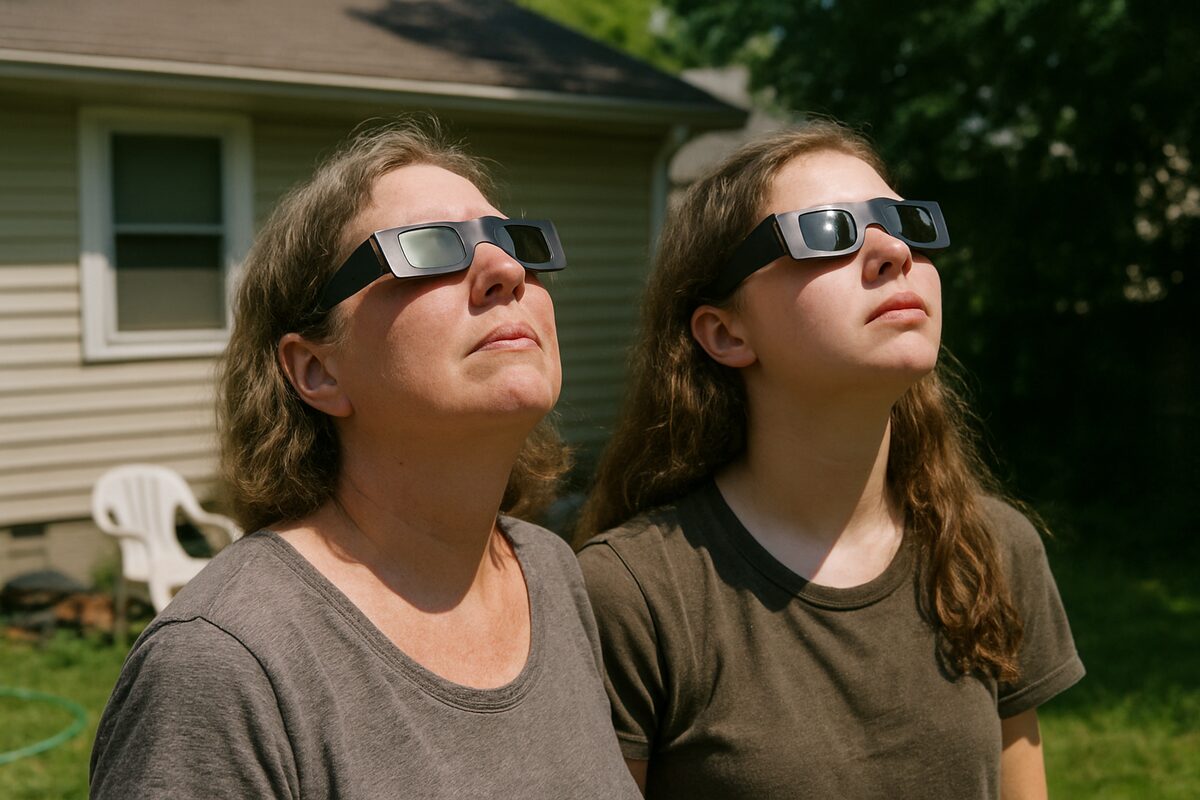
Today — Wednesday, August 12, 2026 — a total solar eclipse crosses Greenland, Iceland, and Spain — and, per NASA, "parts of the northern U.S. (from Alaska to North Carolina)" will see a partial eclipse, beginning "around midday, lingering into the midafternoon for those farther east." That partial label matters for your eyes: NASA's rule is that "During a partial solar eclipse, it is never safe to look directly at the Sun without proper eye protection" — there is no safe naked-eye moment anywhere in the US on Wednesday. Safe viewing means eclipse glasses that meet the ISO 12312-2 international standard — not sunglasses — or an indirect method such as a pinhole projector. The injury at stake, solar retinopathy, is typically painless while it happens, and the American Academy of Ophthalmology states plainly: "There is no treatment for solar retinopathy."
What happens today, and who sees it
Per NASA's eclipse page, "On Aug. 12, 2026, a total solar eclipse will sweep across Greenland, Iceland, northern Russia, the Atlantic Ocean, Spain, and a small corner of Portugal." No part of the United States is in the path of totality; Americans instead get the partial phase — the Moon takes a bite out of the Sun without ever covering it. NASA puts the US viewing zone at "parts of the northern U.S. (from Alaska to North Carolina)", and gives the timing for the northern contiguous states: "the partial eclipse will begin around midday, lingering into the midafternoon for those farther east." Prevent Blindness likewise notes "a partial solar eclipse ... visible in parts of Canada and the northern/northeastern U.S."
Midday on a summer Wednesday means lunch breaks, camps, and kids outdoors — exactly the audience most likely to glance up unprotected.
Why a partial eclipse is the riskier one for casual viewers
It sounds backwards, but a partial eclipse is the more dangerous event for the unprepared. In a total eclipse, there is one brief window — totality itself — when the American Astronomical Society says you may "remove your solar filter only when the Moon completely covers the Sun's bright face and it suddenly gets quite dark." A partial eclipse has no such window. NASA's wording is categorical: "During a partial solar eclipse, it is never safe to look directly at the Sun without proper eye protection." Since the entire US sees only the partial phase on Wednesday, protection stays on for the whole event, start to finish.
The partially covered Sun is also deceptively viewable: glare feels tolerable, so people hold their gaze — while the exposed sliver still delivers full intensity to the retina. The AAO warns that "Looking at the sun without the right eye protection — for even a short time — can damage your retina permanently."
Solar retinopathy: painless while it happens, and no treatment after
The injury has a name: solar retinopathy. Prevent Blindness describes it directly: "This occurs when intense sunlight damages the retina, which can result in blurred vision, blind spots, or permanent vision loss." Two features make it a trap. First, it doesn't hurt: per the AAO, "Damage from the eclipse is unlikely to cause pain or discomfort in your eyes because the retina does not have any pain nerves" — symptoms typically appear "within four to six hours," though some people notice them only after 12. Second, once the damage is done, medicine has little to offer. The AAO states: "There is no treatment for solar retinopathy." A peer-reviewed review in Survey of Ophthalmology reaches the same place — describing only "the limited treatments available" — and notes that while most acute cases improve, "a significant percentage of patients suffer from chronic sequelae: reduced acuity and lifelong central/paracentral scotomas."
In a JAMA Ophthalmology case from the 2017 US eclipse, a young woman who viewed it without adequate protection developed a central blind spot in her dominant eye, with imaging showing a large area of damaged photoreceptors; the authors concluded that "young adults may be especially vulnerable." In Utah alone, 27 patients presented with vision concerns after the 2017 eclipse, six with exam findings consistent with solar retinopathy.
How to watch safely
Real eclipse glasses — and how to know yours are real
Safe solar viewers are not dark sunglasses; NASA notes they are "thousands of times darker and ought to comply with the ISO 12312-2 international standard." The AAS is blunt about the alternative: "Ordinary sunglasses, even very dark ones, are not safe for looking at the Sun; they transmit far more sunlight than is safe for our eyes." The AAO adds that homemade filters are not safe either.
A printed "ISO" label is not, by itself, proof — anyone can print one. The practical check is the seller, not the sticker: the AAS maintains a Suppliers of Safe Solar Viewers & Filters list of manufacturers and dealers whose products it has verified against ISO 12312-2, and advises that "consumers should buy solar viewers directly from known manufacturers or any authorized dealers those manufacturers publicly identify." Its warning: buying from marketplaces or shops "simply 'cashing in' on a solar eclipse is not worth the risk to your eyes." Glasses from 2024 are fine if they came from a listed supplier and the filter is unscratched and undamaged.
No glasses? Use a pinhole — facing away from the Sun
The no-equipment method is indirect projection. NASA's version: "use a pinhole projector, which has a small opening (for example, a hole punched in an index card) and projects an image of the Sun onto a nearby surface." The AAS version needs only your hands: cross "the outstretched, slightly open fingers" of both hands into a waffle pattern and, "with your back to the Sun," watch the crescent shadows on the ground. You look at the projection, never through the pinhole.
Cameras, binoculars, and kids
Optics concentrate sunlight beyond what eclipse glasses can handle. NASA's warning: "Do NOT look at the Sun through a camera lens, telescope, binoculars, or any other optical device while wearing eclipse glasses or using a handheld solar viewer." Children need the same certified glasses as adults, fitted and supervised. Prevent Blindness puts the follow-up rule in family terms: "seek treatment from an eye care professional if you or your child have any changes in vision that continue to get worse."
If you looked anyway
Watch for the symptom cluster the AAO lists: "blurry vision," "a blind spot in your central vision in one or both eyes," "increased sensitivity to light," "distorted vision, in which a straight line looks bent," and changes in color vision — typically emerging within four to six hours, sometimes only after 12. Absence of pain means nothing, for the reason above. There is no home remedy to attempt; if you notice any of these changes after Wednesday, the AAO's advice is simply to see an ophthalmologist. Most acute cases improve on their own, but a significant share of patients are left with lasting central blind spots — which is why prevention is the whole game.
Readers who follow our eye-health coverage may also want our separate report on GLP-1 medications and NAION vision risk — an unrelated topic with the same theme: the retina and optic nerve give you no do-overs.
Bottom line
Today around midday, much of the northern US gets a genuine astronomical event. Enjoy it — through certified glasses from a verified supplier, or projected through a pinhole onto the sidewalk. No US moment of this eclipse is safe for the unprotected eye, and the injury on the other side of that glance is painless, untreatable, and sometimes permanent. There is still time this morning to punch a hole in an index card — and if you are reading this after the eclipse, the symptom section above is the part to read.
Sources
- NASA. Total Solar Eclipse on August 12, 2026. Read August 10, 2026. science.nasa.gov/eclipses/future-eclipses/total-solar-eclipse-on-august-12-2026/
- Prevent Blindness. August 12, 2026 Total Solar Eclipse. Read August 10, 2026. preventblindness.org/solar-eclipses/august-12-2026-total-solar-eclipse/
- American Astronomical Society. Eye Safety — Solar Eclipse Across America. Read August 10, 2026. eclipse.aas.org/eye-safety
- American Astronomical Society. Suppliers of Safe Solar Viewers & Filters. Read August 10, 2026. eclipse.aas.org/eye-safety/viewers-filters
- American Academy of Ophthalmology. Solar Eclipse Eye Safety. April 1, 2024. aao.org/eye-health/tips-prevention/solar-eclipse-eye-safety
- American Academy of Ophthalmology. Think You Hurt Your Eyes Watching the Eclipse? April 20, 2023. aao.org/eye-health/tips-prevention/think-you-hurt-your-eyes-watching-eclipse
- Wu CY, Jansen ME, Andrade J, et al. Acute Solar Retinopathy Imaged With Adaptive Optics, Optical Coherence Tomography Angiography, and En Face Optical Coherence Tomography. JAMA Ophthalmology 2018;136(1):82–85. pubmed.ncbi.nlm.nih.gov/29222532/
- Begaj T, Schaal S. Sunlight and ultraviolet radiation — pertinent retinal implications and current management. Survey of Ophthalmology 2018;63(2):174–192. pubmed.ncbi.nlm.nih.gov/28923583/
- Ricks C, Montoya A, Pettey J. The ophthalmic fallout in Utah after the Great American Solar Eclipse of 2017. Clinical Ophthalmology 2018;12:1853–1857. pubmed.ncbi.nlm.nih.gov/30275682/