
Peptides · Data
US Peptide Market Statistics 2026: Every Number, Sourced
The reference numbers on the US peptide market in one place — prescription GLP-1 revenue from the manufacturers' own financial reports, usage polling, research-firm estimates for the broader peptide-therapeutics and collagen markets, and the FDA enforcement record on the gray market — each number linked to the document it comes from. Cite freely; check us against the sources. For definitions, start with what peptides actually are.
The prescription giants: GLP-1 revenue
The largest peptide business in the world, by a wide margin, is prescription GLP-1 drugs — semaglutide and tirzepatide are both peptides, a point the supplement aisle rarely makes clear (our explainer on why GLP-1 drugs are peptides). The revenue figures below are company-reported results, not projections, with the reporting document named for each.
- Eli Lilly reported $23.0 billion in worldwide revenue for Q2 2026, up 48%, growth it attributes primarily to Mounjaro and Zepbound volume — Lilly Q2 2026 earnings release (quarter ended June 30, 2026, USD).
- Worldwide Mounjaro (tirzepatide) revenue reached $9.9 billion in Q2 2026, up 91% from $5.2 billion a year earlier; US Zepbound revenue was $4.9 billion, up 44% — both from the same Lilly release. Note the scopes differ: the Mounjaro figure is worldwide, the Zepbound figure is US-only.
- Novo Nordisk reported DKK 44.1 billion in adjusted obesity-care sales for the first half of 2026, up 19% at constant exchange rates, in its global half-year report — company announcement No 48/2026 (Novo Nordisk A/S financial report for January 1 to June 30, 2026, published August 4, 2026; all figures DKK, global unless stated). "Adjusted" is the company's own measure excluding non-recurring reversals of US 340B rebate provisions (DKK 26.8 billion recognised in Q1 2026); with that reversal included, reported H1 net sales were DKK 175.3 billion.
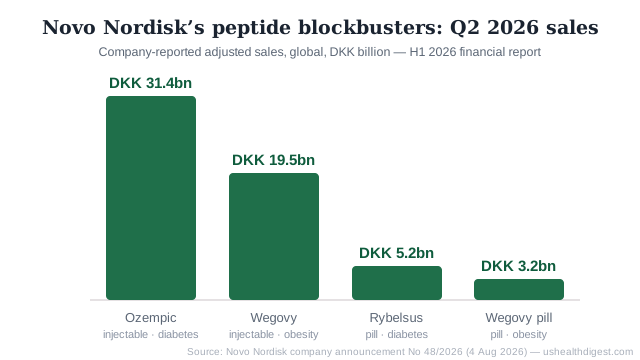
- By brand, Q2 2026 adjusted global sales in the same document — the four bars charted above: Ozempic DKK 31.4 billion, injectable Wegovy DKK 19.5 billion, Rybelsus DKK 5.2 billion, and the newly launched Wegovy pill DKK 3.2 billion. For the first half of 2026, the same table shows DKK 59.2 billion, DKK 37.7 billion, DKK 9.8 billion and DKK 5.5 billion respectively. Every one of those brands is the same peptide, semaglutide.
- The Wegovy pill passed 265,000 weekly US prescriptions in the week ending July 17, 2026, with more than 5 million total prescriptions since launch, per the same Novo Nordisk announcement.
We deliberately do not quote either company's full-year revenue guidance next to these results — guidance is an expectation, not a reported number. For the clinical and usage statistics behind this revenue, see our GLP-1 statistics reference.
How many Americans take peptide drugs
- 11% of US adults report currently taking a GLP-1 medication for weight loss as of mid-2026, and 15% report ever having used one, per Gallup's May 28–June 5, 2026 survey of 5,065 US adults.
- The US adult obesity rate has declined to 36.4% in 2026 from a 39.9% peak in 2022 in the same Gallup tracking — a survey estimate from self-reported height and weight, moving inversely with GLP-1 uptake.
- About 1 in 8 US adults (12%) had ever taken a GLP-1 drug by May 2024, with 6% currently taking one, per KFF's April 23–May 1, 2024 health tracking poll (n=1,479). Two different pollsters, but the direction is consistent: current use roughly doubled between May 2024 and mid-2026.
What the broader market is worth — estimates, and their spread
Beyond the audited revenue above, "peptide market size" numbers come from commercial research firms, not regulators or public statistics. They are estimates built on differing definitions, so we present each strictly as the firm's own figure — and cite two firms per market so the spread is visible.
- Mordor Intelligence estimates the global peptide-therapeutics market at $49.68 billion in 2026, reaching $70.20 billion by 2031 (7.16% CAGR), with North America holding 38.34% of 2025 revenue and the US accounting for roughly 70% of the region — Mordor Intelligence report page.
- Fortune Business Insights estimates the same market at $146.34 billion in 2026 ($131.95 billion in 2025), projecting $334.95 billion by 2034 (10.91% CAGR), with North America at about 38% — Fortune Business Insights report page.
- Those two 2026 estimates differ by roughly threefold. That gap reflects methodology and what counts as a "peptide therapeutic" (insulin and other established peptide drugs are the usual dividing line), which is why we treat these as estimates rather than facts. Notably, both firms put North America near 38% of the global market.
- For collagen peptides — the supplement-aisle side of the market — Mordor Intelligence estimates $1.98 billion globally in 2026 (from $1.84 billion in 2025), reaching $2.96 billion by 2031 (8.43% CAGR), with North America at 34.14% of 2025 revenue and dietary supplements the largest application at 40.34% — Mordor Intelligence collagen-peptides page.
- Fortune Business Insights puts collagen peptides at $3.2 billion in 2026 ($2.86 billion in 2025), projecting $7.77 billion by 2034 (11.75% CAGR) — Fortune Business Insights collagen-peptides page. Whether the products behind those dollars do what the labels imply is a separate question: our evidence review.
Set side by side, the proportions are striking: research firms value the entire global collagen-peptide supplement category for a full year at roughly $2–3 billion — less than the $4.9 billion Lilly reported for US Zepbound in the single quarter cited above. The prescription side dominates the peptide economy. What consumers actually pay on each side: our peptide-therapy cost guide.
The gray market's safety record
Between prescription drugs and legal supplements sits the "research use only" gray market. Its 2026 numbers are enforcement and laboratory findings, not revenue.
- 990 adverse-event reports for compounded semaglutide, plus more than 730 for compounded tirzepatide, had reached the FDA as of May 31, 2026, many involving dosing errors — FDA statement on unapproved GLP-1 drugs. The agency notes these counts likely understate the problem, since state-licensed pharmacies that are not outsourcing facilities are not federally required to report.
- 30 telehealth companies received FDA warning letters on March 3, 2026 — the second batch since September 2025 — for false or misleading marketing of compounded GLP-1s, including implying equivalence to approved products — FDA press announcement.
- Test-purchased "semaglutide" from no-prescription online sellers measured 7.7% to 14.37% pure — against a claimed 99% — and every delivered sample contained endotoxin (2.16–8.95 EU/mg), in a 2024 study in the Journal of Medical Internet Research. Half the orders never arrived at all: of six purchases from illegal online pharmacies, only three vials were delivered. Why a vendor's certificate of analysis does not fix this: our COA explainer.
The regulatory pipeline: the July 2026 compounding votes
- An FDA advisory committee recommended 6 of 7 reviewed peptides for the 503A compounding bulks list at the Pharmacy Compounding Advisory Committee meeting of July 23–24, 2026 — BPC-157, KPV, TB-500, MOTS-c, Epitalon and Semax, with emideltide rejected — per the FDA meeting record and STAT News reporting.
- The BPC-157 vote was 8–6 with one abstention — narrow, and cast against the weight of FDA staff's own scientific review, which had flagged safety and evidence concerns about listing. The recommendation is advisory and non-binding: nothing is legal to compound until the FDA completes rulemaking, and the agency is not obliged to follow the committee. Full background and current legal status: our BPC-157 review.
This page is maintained as a living reference — numbers are updated when the underlying documents change, and the update date above reflects the last review. Company revenue figures are stated in the currency and period of the source document; we do not convert or annualize them.
- Eli Lilly Q2 2026 earnings release (investor.lilly.com) · Novo Nordisk A/S company announcement No 48/2026: financial report, 1 Jan–30 Jun 2026 (PDF)
- Gallup: GLP-1 usage reaches new high (2026) · KFF Health Tracking Poll, May 2024
- Mordor Intelligence: peptide therapeutics · Fortune Business Insights: peptide therapeutics · Mordor Intelligence: collagen peptides · Fortune Business Insights: collagen peptides (all research-firm estimates)
- FDA on unapproved GLP-1 drugs · FDA warning letters to 30 telehealth companies · FDA PCAC meeting, July 23–24, 2026 · STAT News on the PCAC votes · JMIR 2024 semaglutide test-purchase study (PubMed)